

.webp?width=500&height=281&name=Employee%20Engagement%20Trends%202026%20(4).webp)
Key Takeaways:
-
Employee engagement is more than a survey score—it's the emotional connection employees feel to their work, team, and organization, and it directly fuels retention, productivity, and business performance.
-
Real engagement doesn't happen by accident. It takes a credible, research-backed model, leaders and managers who act on feedback, and a strategy that's ongoing—not a once-a-year checkbox.
-
The right employee engagement software brings your people data together, so you can move past scores and dashboards to real insight—and turn that insight into action that builds thriving teams.
Engaged employees don't just show up—they show up ready to give their best. Employee engagement is the emotional commitment people feel toward their organization's mission and goals, and it shows up in the extra effort they bring to their work and how long they plan on staying within the business.
Get this right, and just about every part of your business feels it, including:
- Profitability
- Revenue
- Customer experience
- Employee turnover
- Team dynamics
- ...and much more!
The numbers back this up. Organizations in the top quartile of engagement have a turnover rate 18.8% lower than those in the bottom half, and 9 out of 10 engaged employees intend to stay with their organization over the next year, compared to just 5 out of 10 disengaged employees. Highly engaged employees are also 3.4x less likely to be searching for or applying to other jobs.
Employees who feel connected to their organization work harder, stay longer, and motivate others to do the same. Plus, research shows that 92% of business executives believe engaged employees perform better, boosting the success of their teams and the outcomes of their organizations. It's clear that understanding what drives employee engagement is key to success.
There's a lot of information out there about how to improve employee engagement—some credible, some not. Quantum Workplace has been in the business of employee success for more than 20 years. Through our employee engagement research, we keep a constant pulse on what's changing. In fact, our latest data shows engagement dropped for the first time in nearly a decade, with the share of highly engaged employees falling to 76.1%—underscoring just how easy it is for organizations to lose ground if they aren't intentional about engagement.
In this blog, we'll create a clear understanding of what employee engagement is, while making the business case for its value in your company—and discuss tangible ways to improve your employee engagement strategy.
What is employee engagement?
Employee engagement is a key indicator of a healthy and thriving workplace, where employees feel valued, involved, and connected to their roles and the company at large.
Employee engagement definition
Employee engagement is the strength of the mental and emotional connection employees feel toward the organization that they work for, their team, and their work.
It's about how emotionally invested employees are in their work and the organization's goals. Engaged employees typically display a high degree of commitment, are more productive, and contribute positively to the company culture. They're not just working for a paycheck or the next promotion, but are genuinely interested in their work and motivated to contribute to the organization's success.
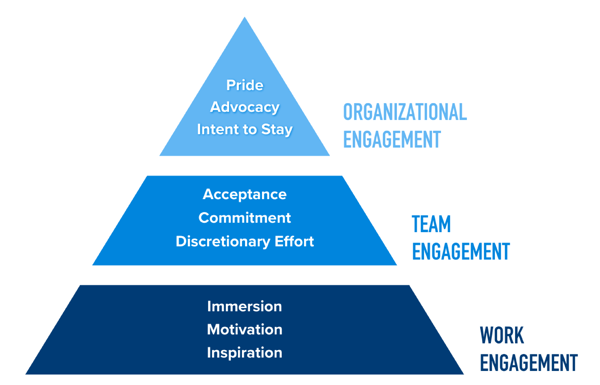
When doing research on employee listening, we found that employee engagement hinges on three factor and three corresponding questions:
- Work engagement: How connected am I to the work I’m doing?
- Team engagement: How connected do I feel to my immediate coworkers?
- Organizational engagement: How connected am I to the organization as a whole?
When looking at these three pillars of engagement holistically, you’ll have a better understanding of engagement levels in your organization.
What are the four levels of employee engagement?
Employee engagement measures how employees feel about their organization. Based on their perceptions of their workplace, employees are categorized into four main groups:
|
Engagement Level |
How They See Their Workplace |
Key Behaviors |
Why It Matters |
|
Highly Engaged |
Hold very favorable opinions of their workplace |
Act as "brand advocates" — speak highly of the company to family and friends; encourage other employees to do their best |
In a Quantum Workplace/Harvard Business Review survey of 984 executives, 81% strongly agreed highly engaged employees perform better and are more productive |
|
Moderately Engaged |
See their organization in a moderately favorable light |
Like their company, but something about the org, team, or job holds them back from full engagement |
Less likely to ask for more responsibility; may underperform relative to their potential |
|
Barely Engaged |
Feel indifferent toward their employer |
Usually lack motivation for their role; do only enough to get by — sometimes less |
May be job-searching; represent a high turnover risk |
|
Disengaged |
Hold a negative opinion of their workplace |
Disconnected from the mission, goals, and future of the organization; lack commitment to role and responsibilities |
Important to know how to handle disengaged employees so their negative perceptions don't spread to others |
What doesn’t define employee engagement
Employee engagement is often used interchangeably with similar concepts like happiness, satisfaction, or wellbeing––but there are some clear differences among these concepts that are important to understand:
Employee engagement is not employee happiness
Some leaders may wonder how to keep employees happy. While important, happiness is not the same as engagement. It says nothing about how invested employees are in the company, nor how hard they’re working on behalf of the organization’s mission. Happiness is a short-term, rapidly changing measurement. For example, an employee may feel temporary happiness from a raise and then sink back into disengagement. Employee engagement is a deep, long-term connection to the organization.
Employee engagement is not employee satisfaction
Employee satisfaction can only be measured at surface level. An employee who is satisfied may not be engaged. Generally speaking, satisfied employees will not take steps to go above and beyond. They usually stick around, but they aren’t driven to go the extra mile. Engaged employees are productive, while satisfied employees tend to coast through their work and experience.
Employee engagement is not employee wellbeing
Employee wellbeing evaluates many areas of an employee’s life, such as how well they cope with stress or if they’re fulfilling their potential. Providing resources to increase employee wellbeing can increase employee engagement. Employee engagement focuses on an employee’s connection with their company—not on their own wellbeing.
Why is employee engagement important?
Recognizing the importance of their workforce, the most successful companies understand that their people are their greatest asset. Why is employee engagement important? Because when employees are motivated and engaged, it unlocks their potential, increases productivity, and fuels sustainable business growth. Cultural alignment alone can boost employee performance by as much as 22%, and investors attribute 65% of the failures in their portfolios to people and organizational issues rather than strategy or product—a reminder of just how much is riding on getting engagement right.
In recent years, there's been a growing emphasis on employee engagement. While the majority of executives acknowledge that engaged employees perform better, only about half report seeing a positive return on investment from their engagement initiatives—56%, to be exact—and just 37% of executives say employee engagement is a high priority for their organization. Interestingly, employees are a bit more optimistic: 62% say their organization has achieved positive results from its investments in engagement.
To bridge this gap, it's crucial for organizations to grasp the core principles of employee engagement. Understanding what drives engagement and how to effectively measure it is essential. This knowledge is key to cultivating a work environment where engagement not only exists but also significantly contributes to the company's success.

10 benefits of employee engagement
Let’s understand the above a bit better by diving further into each of the key benefits of employee engagement.
- Increased employee productivity
Research shows engaged employees are 17% more productive than their peers. They're more likely to work diligently and expend discretionary effort in their jobs. - Higher employee retention
Engaged employees don't have a reason to look elsewhere for work. They turn over less often because they know they will be recognized for their contributions, see opportunities for professional growth and career development, and understand when organizational change happens and why. In fact, 77% of employees say it would take a lot to get them to leave their organization when these pillars are in place. These three pillars enable employees to connect to the present and the future. - Increased customer satisfaction
72% of executives strongly agree that organizations with highly engaged employees have happy customers. Engaged employees care deeply about their jobs, and thus, customers. - Lower absenteeism
When employees are committed to your mission, they're going to show up. Highly engaged workplaces see 41% lower absenteeism. - Better employee health
Engaged employees are less likely to be obese, less likely to suffer from chronic disease, and more likely to eat healthier and exercise. Having healthier employees positively impacts your bottom line because employees can show up to work fully present. - Decreased workplace injury
Employees are more aware of their surroundings and can focus on the task at hand. Research has shown that 70% fewer safety incidents occur in highly engaged workplaces. - Greater trust in leadership
Engaged employees believe that senior leaders of their organization demonstrate integrity and are doing their best to drive future success. This trust runs deep at the top: 94% of executives and directors report trusting senior leaders to guide the company to future success. They also feel valued and like their opinions matter. - Stronger employer brand
Employees become vocal advocates and recommend your workplace, which is crucially important in an aggressive talent market. Employees who receive meaningful recognition and rewards are 88% likely to recommend their organization as a great place to work, compared to just 66% of those who don't. - Reduced stress and burnout
Engagement and trust go hand in hand with wellbeing. Employees at high-trust organizations report 74% less stress, 106% more energy at work, and 40% less burnout than those at low-trust organizations—along with 13% fewer sick days and 50% higher productivity. - Greater resilience through change
Change is inevitable, and engaged organizations weather it better. 72% of organizations report that a strong culture helps successful change initiatives succeed—critical, since 62% of employees say they've seen coworkers quit as a direct result of poorly managed organizational change.
Why employee engagement alone can’t solve all organizational issues
Employee engagement is crucial for a productive workplace, but it's not a standalone solution for all organizational challenges. A comprehensive approach that includes employee experience, performance management, and a solid talent strategy is essential. Here’s why:
- Employee experience: Employee experience extends beyond engagement, encompassing every interaction from recruitment to exit. It shapes overall satisfaction and, in turn, influences engagement levels. A positive experience can boost engagement, but focusing only on engagement overlooks other crucial aspects of the employee journey.
- Performance management: Performance management is also critical. A solid performance management approach ensures that employees are not just engaged but also growing and contributing meaningfully.
- Talent strategy: A holistic talent strategy aligns workforce capabilities with organizational objectives. It covers talent acquisition, retention, employee development, and planning. While engagement is a component, a broader talent strategy ensures no opportunities are missed, and workforce gaps are addressed.
Overall, while employee engagement is incredibly important, it should be part of a broader employee success strategy.
What are the top drivers of employee engagement?
Employee engagement drivers are items that have a large impact on employee engagement outcomes. They are the items you should take action on when driving employee engagement.
All drivers will impact engagement—the key is to identify and act on the drivers that will make the biggest difference in your organization. And implement strategic employee engagement activities that support those drivers.
Top 10 drivers of employee engagement:
- My job allows me to utilize my strengths.
- I trust our senior leaders to lead the company to future success.
- I believe this organization will be successful in the future.
- I find my job interesting and challenging.
- The senior leaders of this organization value people as their most important resource.
- My opinions seem to count at work.
- If I contribute to the organization’s success, I know I will be recognized.
- I see professional growth and career development opportunities for myself here.
- The senior leaders of this organization demonstrate integrity.
- I have the information I need to do my job well.
From this list, there are three key themes that are powerful indicators of employee engagement. They describe what is core to connection and engagement in your workplace.
3 key themes that are powerful indicators of employee engagement
The 11 trends impacting employee engagement according to Quantum Research
Magnetic Culture
1. The "Big Stay" is here
Quit rates have dropped, but so has engagement — highly engaged employees fell to 76.1% in 2023, the first decline in nearly a decade. Employees still signal when they're a flight risk: 62% discuss leaving with a manager or coworker first, and warning signs include unfair pay, no recognition, and missed growth conversations.
2. You can't get by with mediocre culture
Two-thirds of employees say culture shapes their work and behavior every day, and disengaged employees are 2.6x more likely to leave for a better one. 83% say leadership carries the leading role in shaping it.
Employee Experience
3. Burnout is more than just stress
37% of employees report high burnout, and it's costly — 1.7x less engaged, 2.1x more likely to be job hunting. Only 40% say staffing is sufficient to manage their workload, and frequent AI users report slightly higher burnout, not less.
4. Employees expect post-survey action
Two in three employees don't see enough follow-through after surveys, most often blamed on a lack of time and resources (21%) or unwilling leaders (20%). Get it right, though, and employees are 5x more likely to see positive ROI from engagement efforts.
5. Engagement is the key to strong retention and performance
Top-quartile engaged organizations see 18.8% lower turnover, and 9 in 10 engaged employees intend to stay next year vs. 5 in 10 disengaged.
Performance & Impact
6. Employees say there's room to improve performance management
More than 2 in 3 employees say manager feedback is vital to improving performance, but only about 1 in 10 use performance tools weekly — a gap between how often people talk and what actually gets tracked.
7. Performance reviews are low performing, high potential
Nearly 2 in 3 employees still get only an annual review, but more frequent reviews drive 11% more engagement and 5% more perceived performance improvement.
8. Managers matter — but they don't feel supported
39% of managers have had zero management training, yet managers who use technology well are 3.4x more effective. There's also a 24-point gap between how managers see their own coaching and how employees see it.
9. Employees want to drive organizational success
Employees with individual goals are 2x more likely to be engaged, rising to 3.2x when those goals align with organizational goals. Still, 46% want more feedback than they currently get.
Emerging Intelligence
10. Organizations still aren't ready for AI
Only 1 in 5 employees frequently use AI at work, and almost half never have. Just 1 in 4 feel confident in their organization's AI strategy, and only 16% say their manager encourages AI use.
11. Change isn't the problem — how you manage it is
Only 36% of employees learn about change before or as it happens, even though early communication makes employees 3.2x less likely to consider leaving over it. Frequent communicators see 79% engagement vs. 41% at organizations that rarely communicate about change.
What key roles drive employee engagement?
The truth is, everyone owns employee engagement.
Every person in your organization has an impact on the quality of relationships they build, their approach to teamwork, and general attitudes they bring to the workplace. Here is a breakdown of employee engagement roles.
| SENIOR LEADERS |
|
| HR |
|
| MANAGERS |
|
| EMPLOYEES |
|
3 reasons why employee engagement efforts can fall short
Employee engagement initiatives often fail due to three primary reasons:
1. Lack of a credible employee engagement model.
Many organizations struggle with engagement efforts because they don't use a credible or scientifically-backed model to uncover what truly drives engagement. Understanding the deeper meaning behind employee behaviors and sentiments is crucial, and will uncover obstacles and opportunities that are helping or hindering employee success overall.
By working off of a proven model that goes beyond surface-level metrics to unravel the genuine factors influencing employee engagement, you’ll gain deeper insights that will help tailor your organization’s strategies to your unique employee-base.
2. Challenges in taking action on employee feedback.
Another common pitfall is the complexity and difficulty of translating engagement insights into tangible actions. Many companies utilize surveys to uncover what the employee experience looks like at their organization, and find straightforward ways to act on the information. However, just 35% of employees say their organization is effective at post-survey action.
If you act on engagement survey results, you’ll build trust with employees and show them that you’re listening––but we understand that this takes actionable insights. Finding a software partner that can uncover those for you through action-oriented surveying is vital.
3. Not partnering with the right employee engagement software.
Your software partner matters as much as your strategy. Look for a platform that's reliable, easy to use, and built to fit the way your team already works—so managers actually adopt it instead of avoiding it. Beyond survey tools, the best partners connect engagement, performance, and development data into one place, giving you insights you can act on instead of just admire.
And just as important: look for a trusted partner who shows up as an expert guide, not just a vendor. You want a team invested in your success long after the contract is signed.
Quantum Workplace's employee engagement software does exactly this—bringing your people insights together so you can build stronger managers, spot your top talent, and keep the people who matter most.
What is an employee engagement model?
An employee engagement model offers a stable and systematic method to assess and enhance engagement levels. This framework assists in clearly identifying the elements that both promote and impede engagement within an organization. It enables businesses to pinpoint and understand the various factors currently impacting employee engagement.
Why is an employee engagement model important?
A good employee engagement model helps you measure how engaged your employees are, guiding you in understanding, analyzing, and improving engagement. Using a proven, science-backed model means you can focus on what really matters from your employee feedback, separating signals for action from employee feedback noise. This helps you make your workplace better without wasting time or money on initiatives that don’t work.
4 employee engagement model examples
A few exemplary employee engagement models from other organizations include:
Aon Hewitt’s Engagement Model
Aon Hewitt’s model focuses on four key dimensions of engagement:
- Say: employees’ willingness to speak positively about the organization
- Stay: employees’ intention to remain with the organization
- Strive: employees’ willingness to put in extra effort
- Share: employees’ inclination to advocate for their company as a great place to work
Gallup’s Q12 Engagement Model
Gallup’s Q12 model consists of 12 survey questions that assess different aspects of employee engagement. The questions cover topics such as clear expectations, recognition, development opportunities, and the presence of a best friend at work.
Deloitte Employee Engagement Model
Deloitte’s model leverages five engagement-driving elements, including:
- Meaningful work: autonomy, select to fit, small & empowered teams, time for slack
- Hands-on management: clear & transparent goals, coaching, manager development, modern performance management
- Positive work environment: flexibility, humanism, recognition, DEI
- Growth opportunity: training & support, mobility, learning culture
- Trust in leadership: mission & purpose, investment in people, transparency, inspiration
The Quantum Workplace employee engagement model
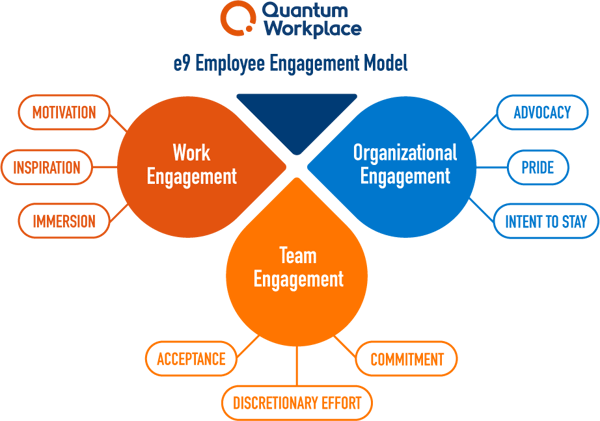
Quantum Workplace has helped organizations design, build, and scale employee engagement strategies and surveys by using our e9 employee engagement model. This scientifically-backed model is well-researched and highly effective at helping organizations drive employee engagement using actionable insights. This model ties back to our pyramid noted in the beginning of this blog that measures: work engagement, organizational engagement, and team engagement.
Employee engagement best practices
In the modern workplace, employee engagement is so much more than a survey. Here are a few employee engagement best practices to help you maximize your efforts. These employee engagement ideas will make all the difference in the employee experience.
Reaffirm areas of strength.
Yes, there is always room to improve. But don’t be afraid to highlight your strengths as well. Celebrate engagement wins and socialize successes with current and prospective employees. When employees see meaningful action and improvement, they’re more likely to be engaged.
Tie engagement efforts to business outcomes.
You need everyone on board to make your engagement plan a success—and that means proving real impact. Connect your engagement efforts to tangible business results such as turnover rates, sales, customer satisfaction, financial performance, and more. When leaders and employees see the impact of engagement, they’re more likely to be invested in the process.
Make engagement a strategy, not an activity.
If you want to move the needle on engagement, it must be a continuous strategy—not a one-off project you set and forget. When engagement is only addressed every once and awhile, employees don’t feel heard or supported, and managers don’t take it seriously. If you listen to your employee and prioritize engagement throughout the year, you’ll see greater engagement and a better return on the investment of your time, energy, and dollars.

Measuring employee engagement: How to start
Before you can improve employee engagement, you have to know where you stand. How do you measure employee engagement? One of the most accurate and efficient ways to gain understanding is with employee surveys.
3 approaches to measuring culture and engagement
As you grow your understanding of the employee lifecycle, you’ll also want to uncover group and demographic dynamics that are impacting employee engagement. You'll want to measure employee engagement:
|
Level |
Approach |
What It Gives You |
|
1. Organization-wide |
Use a company-wide employee engagement survey to establish a baseline |
A 30,000-foot view of strengths and opportunities; a benchmark for teams and groups, as well as future engagement surveys |
|
2. Within groups and teams |
Slice organizational data to understand nuances across teams, groups, and demographics; dig deeper with employee focus groups and pulse surveys |
Identification of specific areas that need attention beyond the org-wide picture |
|
3. Among individuals |
Use one-on-one meetings, feedback, and recognition — not just surveys — to understand engagement at the individual level |
Individual-level insight, with managers playing a critical role in the effort |
Developing a measurement strategy
After having a better understanding of who the survey will reach, you must identify an end goal. Decide on the impact you want the survey to have, and then work backward from there. Ask yourself:
- Who will be accountable for following up on these results?
- Who will be acting on these results?
- What does that action look like?
Why use surveys for effective employee engagement
Engaging your talent is key to employee, team, and business success. Help your leaders focus on what matters, your managers become better coaches, and your employees do their best work with the right employee engagement tools.
What do employee engagement surveys help with?
Employee engagement surveys play a crucial role in understanding and enhancing the workplace environment. Here's how they help:
- Measuring employee sentiment
- Identifying strengths and weaknesses
- Improving communications
- Facilitating strategic planning
- Enhancing employee retention
- Boosting productivity
- Promoting a positive work environment
- Benchmarking performance
- Tailoring development programs
- Predicting future trends
Why employee engagement survey design matters
The design of an employee engagement survey plays a crucial role in understanding and improving workplace dynamics. A well-designed survey does more than gather data; it provides actionable insights and fosters a culture of continuous improvement. Here are the key elements that make for an effective survey design:
1. Science/Research-Backed Questions
The strength of any survey lies in its questions. Using research-backed questions ensures that each query is purposeful and actionable. This approach helps organizations understand the specific drivers of engagement within their workforce and what steps can be taken to enhance it.
2. Measurement Scale
A standard measurement or agreement scale is a vital tool for improving the quality of survey data. See why we recommend a 6-point Likert scale for most surveys.
3. Integrated, Open-Ended Questions
While structured questions are essential, open-ended questions bring a different dimension to the survey. They allow employees to provide more detailed feedback and share specific examples. This qualitative data can be invaluable in understanding the nuances of employee sentiment and identifying areas for actionable improvement.
3 valuable surveys for measuring employee engagement
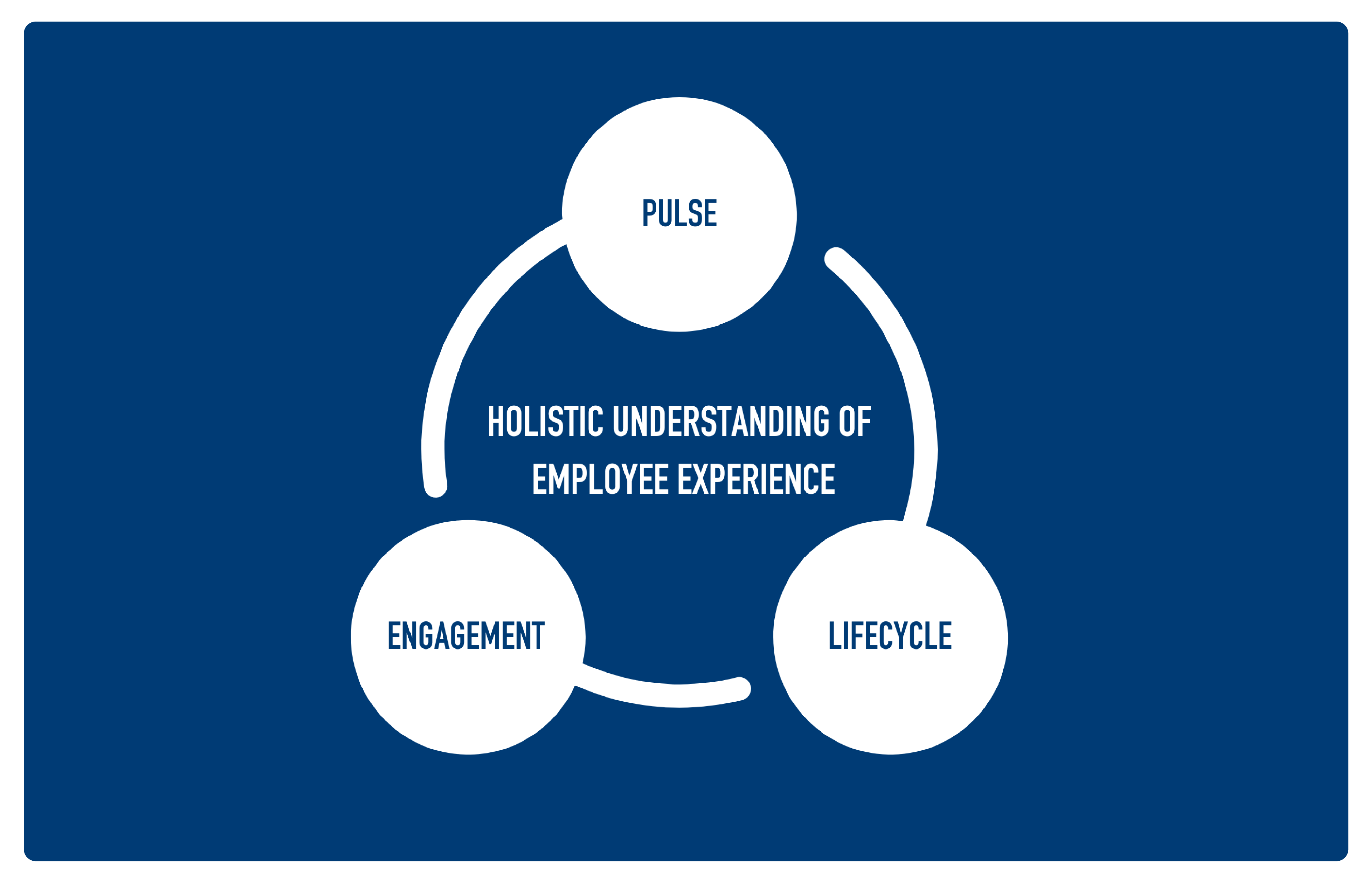
1. Employee engagement surveys
A comprehensive employee engagement survey helps leaders understand engagement at the organizational level. These surveys should include questions that are scientifically proven to measure employee engagement.
2. Pulse surveys
Pulse surveys are designed to help organizations gather real-time feedback on any topic at any time. This is especially important during times of transition—such as acquisitions and mergers, mission or focus changes, and executive or management changes.
3. Employee lifecycle surveys
Employee lifecycle surveys allow you to collect feedback from employees during key moments in their tenure at your organization. Examples include:
-
- New Hire Survey: What do new hires think of your onboarding process? What was their perception at the 30-, 60-, and 180-day marks? What’s their outlook on the future? With the right questions, you can gain the insight that helps you engage new hires now and in the future.
- Stay Survey: Why are employees still working at your company? What could drive them to leave? What can be done to prevent it? Questions like these help prevent unwanted talent loss by keeping tenured employees engaged.
- Exit Survey: Why did an employee leave your organization? How did the turnover impact remaining employees? What can you do to prevent others from leaving? The insight you'll gain from exit surveys will help you be more strategic in your engagement initiatives.
Employee engagement survey questions you can ask for each audience
When designing employee engagement surveys, it's important to target different levels within the organization. Here's how you can approach each audience:
Organization-wide
- Overall, how satisfied are you with your experience at our company?
- Do you feel aligned with the company's core values and mission?
- How likely are you to recommend our company as a great place to work?
Within Groups and Teams
- How effectively does your team collaborate on projects?
- Do you feel your team's contributions are valued by the organization?
- Can you give an example of effective communication within your team?
Among Individuals
- Do you feel your individual work aligns with the company's goals?
- How adequately are your skills and talents being utilized in your current role?
- Can you share an instance where you felt personally valued and recognized for your contributions?
How to action your employee engagement survey results
Effectively utilizing survey results is crucial but often challenging due to common barriers. To overcome these, you need straightforward strategies for responding to employee feedback. This means having a plan for communication and action.
Your employee engagement communication strategy helps your organization continually evaluate, discuss, and adjust how you are approaching the employee experience. When you make engagement a topic of ongoing discussion, it becomes a sustainable, business-driving part of your culture.
Action planning shouldn't be overwhelming or limited to HR––it's about fostering a culture of active listening and meaningful response across the organization. Key challenges of action planning include:
- Limited time, resources, and prioritization
- Lack of leader and manager buy-in
- Poor communication.
Address these by scheduling time for analysis, discussion, and planning, ensuring leaders and managers are invested in the process, and maintaining clear communication throughout.
To simplify and take action on your survey results, we encourage you to:
- Be Brave: Don't get stuck on the scores. Focus on using feedback to progress, not achieving perfection.
- Make it Human: Remember the people behind the data. Use the information to understand and improve the employee experience.
- Share the Load: Involve everyone in the organization. Leaders and managers should facilitate team-level discussions and commitments.
- Do the Next Right Thing: Start with small, manageable improvements. Encourage leaders to focus on one key area for development.
- Lean on Tools: Utilize tools that simplify collecting feedback, analyzing results, and acting on insights. Your process should be efficient and not overly burdensome for your team.
Remember, the goal is continuous improvement to enhance employee experience and overall engagement.
How to create an employee engagement action plan
Creating an effective employee engagement action plan is a vital step in transforming workplace dynamics. It's where you turn insights into impactful actions. At the core of this plan, you'll identify and discuss the key drivers of engagement within your organization.
But empowering your people to drive action planning is often a challenge. Quantum Workplace's AFTER framework helps HR teams and their managers:
- Navigate the vast expanse of employee feedback
- Discover actionable insights
- Develop a plan to keep everyone on course for next-level employee engagement
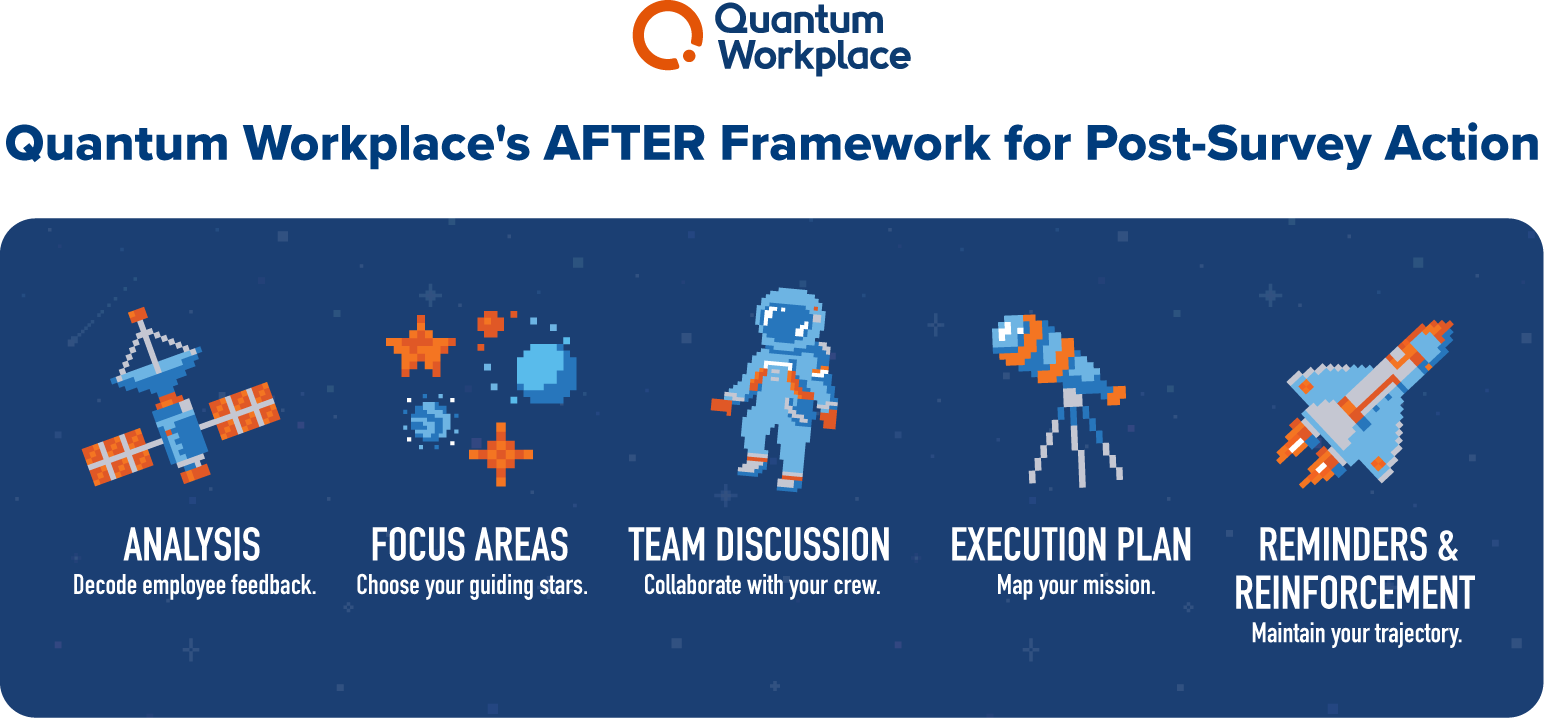
1. Analysis: Decoding Employee Feedback
The first step to effective action is making sense of your survey results. Your goal is to help your leaders and managers analyze survey results with ease. You need to:
- Unearth insights: delve into survey results to spot engagement highs and lows
- Empower managers: share data early for impactful, team-led change
- Go beyond the score: identify themes and find context to guide improvement
2. Focus Areas: Choosing Your Guiding Stars
Analysis without focus can feel like navigating the universe without a compass. You need guiding stars to help you prioritize what matters most. Aim to:
- Prioritize strategically: choose 2-3 areas for targeted execution
- Loop in leaders: encourage leaders and managers to set team priorities
- Focus on impact: elevate areas with the most potential to boost engagement
3. Team Discussion: Collaborating with Your Crew
Effective action planning cannot happen in a vacuum. Involving employees in the process helps them understand their feedback is being taken seriously. You need to:
- Tap team intelligence: utilize team brainstorms for collective problem-solving
- Dive deeper: ask questions to understand and improve the areas that matter most
- Get creative: foster open dialogue and design thinking for innovative employee engagement ideas and action
4. Execution Plan: Mapping Your Mission
It’s time to launch! You need an execution plan that is specific, measurable, and well-communicated to guide you. You need to:
- Build your roadmap: craft a clear action plan with defined initiatives
- Ensure accountability: assign responsibilities and deadlines for measurable impact
- Check alignment: make sure actions align to focus areas
5. Reminders & Reinforcement: Maintaining Your Trajectory
Once your plan is launched, it’s essential to keep action top-of-mind to remain on course. This means communicating, tracking progress, and adjusting your plans as needed. You need to:
- Keep dialogue open: maintain regular communication and updates on plans
- Check in with managers: follow up to track progress and navigate challenges
- Evolve continuously: adapt plans to new insights and successes along the way
Leveraging employee engagement software
An engaging employee experience is table stake for creating a culture of employee success. You need critical insight into what's driving and stalling employee engagement. Capture employee feedback, uncover meaningful insights, and take targeted action to propel your business forward with the right employee engagement software.
|
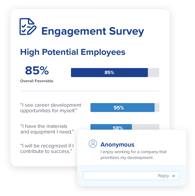
Employee Engagement SurveysUncover what's helping and hindering employee engagement. Measure employee engagement easily and accurately—and act on it in a strategic and speedy way—with employee engagement survey software. Best for: HR teams running annual or biannual engagement checks who need benchmarked, statistically valid results leadership can trust. |
|
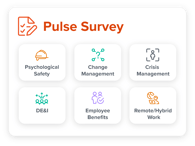
Employee Pulse SurveysDon't wait for your annual engagement survey to check on engagement. Get a pulse on what employees are feeling at any given time. Collect employee feedback efficiently on any topic, any time with pulse surveys. Best for: organizations navigating change—reorgs, new leadership, return-to-office—who need frequent, lightweight feedback between bigger survey cycles. |
|
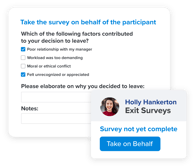
Employee Lifecycle SurveysAssess and improve employees' experience at every phase of their journey with employee lifecycle surveys. Uncover insights at critical moments and milestones and act on them before it's too late. Best for: teams focused on retention who want to catch flight risks and friction points at onboarding, key milestones, and exit—not just once a year. |
|
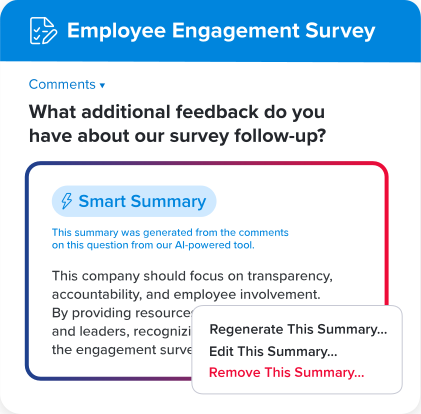
Employee Engagement Reporting & AnalyticsUnderstand the state of engagement and empower action with on-demand insights. Make sense of your complex people data at-a-glance with robust employee engagement analytics and reporting capabilities. Best for: HR and business leaders who need to translate survey data into a clear story for managers, executives, and the board. |
|
Employee Engagement BenchmarksGet context that builds confidence with best-in-class comparisons and benchmarks. Compare your engagement results to similar organizations in your industry, region, or size range. Best for: leaders who need outside context to know whether their scores are actually good—not just numbers in a vacuum. |
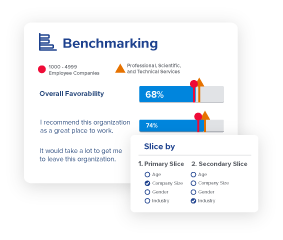 |
BenchmarkingWhen comparing your employee engagement against like minded organizations, having access to a large database of quality data that helps you understand how you measure up is key. From company demographics to benchmarking tools, ensure your software gives you the right tools to understand how you’re doing. Best for: organizations that want credible, apples-to-apples comparisons instead of generic industry averages. |
|
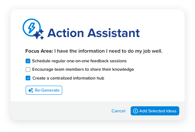
Employee Engagement Action PlanningCreate visibility and accountability into post-survey action. Reduce time-to-action and increase impact. Enable managers to own and follow through on action items. Best for: HR teams tired of surveys that end in a report instead of results—this turns insights into follow-through at the team level. |
-1.png?width=193&height=105&name=image%20(8)-1.png)
|
Coming Soon: Insights HubMove beyond dashboards to a virtual analyst and coach built into your Quantum Workplace platform. Insights Hub connects the dots across engagement, performance, and development data to surface the patterns a single metric would miss — then delivers clear, plain-language explanations of what's happening, why it matters, and what to do next. Insights are organized around the topics that matter most to your organization, like manager effectiveness or top talent retention, and delivered right where your leaders already work in Microsoft Teams, so nothing gets stuck in a report no one opens.
|
Checklist: How to evaluate employee engagement software vendors
We've been hearing "the future of work is digital" for years—and that future is now. 61% of CEOs expect their business to become more digital, and half of HR professionals plan to invest more in technology this year. To get engagement right, you need a platform built for the job.
Use this checklist to make your employees' voices heard, uncover insights that matter, and choose software you can build a real strategy on.
☐ Start with the business problem.
Before you shop for software, get clear on the problem you're actually trying to solve. Your technology should support your key HR objectives—and those objectives should ladder up to your broader business goals.
☐ Involve the right stakeholders at the right time.
Rolling out an engagement platform is a big change, and big changes go smoother with buy-in. Bring in the right people early: Who's invested in this problem? Who will make or break your program's success? Who are your champions, and who might need convincing?
☐ Understand your time to ROI.
This is a real investment of time, money, and energy—so plan to make the case for it. Get specific about what you're trying to achieve, and tie it back to outcomes your leaders actually care about.
☐ Look for a research-backed engagement model.
Anyone can ask employees how they feel—not everyone can tell you why it matters. Look for a vendor whose survey methodology is grounded in real research, like the Quantum Workplace Employee Engagement Model (e9), a scientifically-backed framework that measures nine drivers of engagement across work, team, and organizational levels. A strong model turns feedback into a real diagnostic, not just a temperature check.
☐ Look for depth, not just data collection.
Plenty of tools can send a survey. Fewer can connect engagement data with performance, development, and retention signals to show you the full picture. Make sure your platform helps you see patterns—not just percentages.
☐ Prioritize ease of use and adoption.
The best insights don't matter if managers won't log in. Look for software that's intuitive enough that people actually use it, and that fits into the way your teams already work.
☐ Check for credible benchmarking.
Numbers only mean something in context. Make sure your vendor has a large, high-quality database that lets you compare your results to organizations like yours—not just generic industry averages.
☐ Confirm the path from insight to action.
Data without action is just a report. Look for built-in action planning that creates visibility and accountability, so managers actually follow through on what the data tells them.
☐ Ask about security and scalability.
As your organization grows, your platform should grow with you. Make sure the vendor can handle your data securely and scale alongside your business, not hold it back.
☐ Choose a true partner, not just a platform.
Software is only half the equation. What matters just as much is the team behind it—the people who listen, take your feedback seriously, and help you get the most out of the tool. Look for a partner who helps you find the meaning in your data, empowers your whole organization to act on it, and sticks with you until those actions turn into results.
Click here to see our in-depth evaluation of employee engagement software vendors.
Now that you know what employee engagement is, why it’s important, and how you can make a difference – it’s time to get to work. If you’re looking for an employee engagement software that can support your strategy, learn about what makes Quantum Workplace stand out from the crowd.
FAQs
What is the difference between employee engagement and employee satisfaction?
Employee satisfaction reflects how content employees are with their jobs, while employee engagement reflects the connection, motivation, and discretionary effort employees bring to their work. Satisfaction can be passive; engagement is more closely tied to performance, commitment, and action.
What are examples of employee engagement strategies?
Examples include manager action planning, recognition programs, career growth conversations, employee listening programs, communication improvements, leadership transparency, goal alignment, and team-level follow-up after survey results.
How often should companies measure employee engagement?
Most organizations run a comprehensive annual or semi-annual engagement survey and supplement it with pulse surveys or lifecycle surveys throughout the year. The right cadence depends on workforce size, change velocity, and the organization’s ability to act on results.
Want to see how Quantum Workplace can help you understand and improve your employee experience? See our employee engagement software in action with a custom demo today!