


.webp?width=500&height=281&name=Employee%20Engagement%20Trends%202026%20(4).webp)
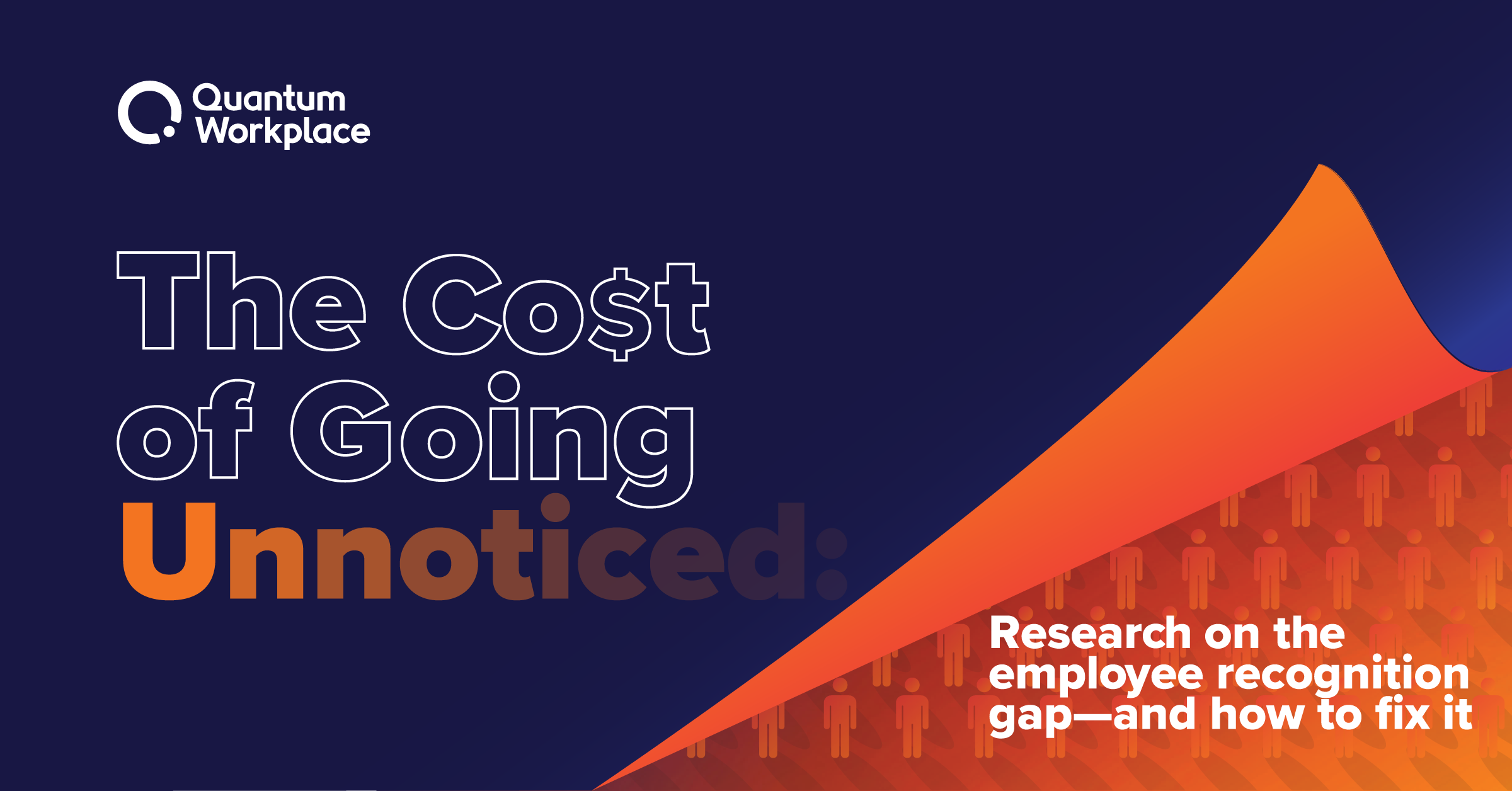
Companies are investing in recognition programs, but many are missing the mark. According to the 2026 Quantum Workplace recognition research, 40% of employees say the recognition they receive doesn't feel meaningful. Only 55% would call their culture of recognition strong, and 3 in 5 describe it as inconsistent, top-down, buried in approvals, or barely there.
The biggest surprise was 1 in 5 said they got zero recognition at all last year.
Zero. Not "a little." An entire year of showing up, doing great work, and hearing nothing from their managers.
That's the recognition gap: the space between the programs companies put in place and how unnoticed employees still feel. And once you see how it happens, it's pretty fixable.
What is the employee recognition gap?
The recognition gap is the space between how much organizations are investing in recognition and the outcomes those investments actually drive, like how employees feel, engagement, retention, and motivation. It shows up as praise that arrives too late, recognition that only reaches a few people, or recognition that feels more like a formality than a real "we see you."
It's rarely a caring problem. Most leaders genuinely want their people to feel valued.
It's a timing and design problem.
Someone does great work in January, and the only acknowledgment shows up in an April review, long after anyone remembers the details.
Recognition stays limited to quarterly awards that only so many people can win.
HR tries to route recognition through managers on the theory that managers know who deserves it. Except managers are busy, and they simply don't see everything.
And recognition is often disconnected from what matters to the organization, diluted down to plain courtesy like someone holding a door and getting a quick thanks. That's politeness. It's not the same as being recognized for work that mattered.
What's widening the recognition gap?
The gap keeps widening because most programs get one of two things wrong: how often recognition happens, and whether it actually means anything when it does.
Take frequency first. Some leaders worry that recognizing people more often cheapens it, like it stops feeling special once it's not rare anymore. But that's backwards. The data shows frequency and meaning actually move together, and organizations that recognize people more often see stronger engagement and retention, not weaker. When recognition only shows up a few times a year, it's not being protected. It's just going missing most of the time, which is exactly the kind of gap employees notice.
Then there's meaning, and this is where a lot of well-intentioned programs quietly fall apart. Getting recognized more often only helps if the recognition actually feels like it was for you specifically, tied to something you did, not a generic shoutout that could apply to anyone. A reward makes a real difference here: people who get one alongside their recognition are 4.8 times more likely to call it meaningful, and 87% of employees with some choice in their reward say it felt meaningful, compared to just 52% of those without a choice.
That disconnect also traces back to five specific design flaws:
|
Design flaw |
What employees actually say |
|
Random acts of recognition |
47% don't think recognition ties to real contributions; 1 in 5 don't know what behaviors to recognize in the first place. |
|
Infrequent, high-friction recognition |
Only 5% get recognized weekly; 1 in 3 admit they simply forget to give it |
|
Impersonal and intangible recognition |
54% get no reward with their recognition; half say it doesn't feel personal |
|
Top-down and hidden recognition |
19% got zero recognition from a manager all year; most employees don't care who it comes from |
|
Siloed and disconnected recognition data and tools |
84% of leaders are juggling 3 to 10 different platforms; only 5% have anything connected |
Do you have an employee recognition gap?
Your first point of call should be to look at your employee engagement survey results. If you're already surveying employees, the answer is probably sitting in data you have.
Start with the recognition-specific items: whether employees feel recognized for the work they actually do, whether they believe they'd be recognized if they helped the organization succeed, and whether recognition at your organization feels genuine rather than routine. Then look at what those scores are doing to retention intent items, like whether it would take a lot to get someone to leave.
Don't stop at the company-wide average, though. Recognition tends to vary widely by team and by manager, so a strong overall score can hide teams that are struggling. Cut the results by department, by manager, by tenure, and by location before deciding you don't have a gap. The teams quietly going unnoticed are usually the ones the top-line number won't show you.
Beyond the survey, watch how people show up day to day. The gap tends to announce itself.
- They've checked out. Distracted in meetings, going through the motions, no real spark behind the work.
- They've gone quiet. Conversations get shorter, and they stop raising their hand for team projects or extra work.
- Their hours start slipping. Later arrivals, earlier exits, less time actually at their desk.
- The mood has flattened. Tired, bored, a little flat. Not dramatic, just off.
- The work itself is slipping too. Output that used to be sharp is now noticeably thinner, in quality or quantity.
- They've stopped leaning in. Training, stretch projects, development opportunities. They skip them now.
None of these signs prove recognition is the problem on their own. But taken together, especially across more than one person, they're usually a sign that people don't feel seen for what they're contributing, and that's worth digging into before it turns into an exit interview.
What going unnoticed actually costs you
Recognition isn't a soft, feel-good metric. It's a retention lever, and one most organizations are barely pulling.
Here's the number that should worry leaders most: 45% of employees don't believe they'll be recognized even if they help the company succeed. That belief doesn't just sit there quietly. It shapes how much effort someone puts in, and whether they stick around long enough to keep giving it.
The flip side makes the stakes obvious. When recognition is designed well, employees are 7.2 times more likely to stay. Employees recognized monthly or more often are 80% highly engaged, and among employees who say recognition is meaningful, 56% say it makes them want to stay longer.
Put those together and the pattern is hard to miss. Recognition isn't just about a good moment for the employee. It's one of the more direct, most under-used ways to keep the people you'd hate to lose.
Why recognition is key to building thriving teams
Thriving teams tend to share four things: they're aligned around what matters, empowered to make decisions, growing in their skills, and valued for what they contribute. All four have to be true at once. A team can be aligned and growing and still quietly struggle if people don't feel like their work matters.
Of those four, feeling valued is where recognition shows up, and it's also the condition most organizations are missing. You can give someone clear goals, real autonomy, and every development opportunity in the book, and they can still walk away feeling like none of it was noticed. Recognition is what closes that specific gap. It's the difference between doing good work and having that work actually seen.
And it doesn't just feel good in the moment, it changes what people do next. In the weeks after being recognized, 65% of employees look for more ways to contribute, 59% put in extra effort, and 54% say they'd recommend their organization as a great place to work.
5 ways to close the recognition gap
None of this takes a huge budget or a perfect starting point. It takes intention, and a willingness to admit your current program might not be doing what you think it's doing.
- Recognize what matters most. Tie recognition to real behaviors and outcomes instead of generic praise. Right now, only 60% of employees say recognition helps them understand what's actually valued.
- Make recognition easy, frequent, and in-the-flow of work. Build it into tools people already use, refresh budgets monthly instead of annually, and cut the approval step that turns a real moment into a delayed one.
- Leverage rewards to amplify and personalize recognition. 82% of employees say recognition lands better with a reward attached. Choice matters more than size.
- Allow recognition to scale visibly across the organization. Recognition doesn't have to flow through managers to count. Most employees don't have a preference on who it comes from, they just want it to happen.
- Connect recognition data and use it as leadership intelligence. Recognition is a real-time signal of where great work is happening. Treat it that way instead of letting it sit in a feed nobody reviews.
Companies that do all five land in what the research calls "consistent and embedded" recognition, and it's not a subtle difference. Employees in these organizations are more than twice as likely to stay than in organizations where recognition is rare or absent.
How Quantum Workplace helps you close the recognition gap
Quantum Workplace's employee recognition software was built around these exact fixes, not around vague inspiration.
Peer-to-peer recognition lets anyone recognize anyone, right inside Slack, Microsoft Teams, or the platform itself, so it happens where work already happens instead of becoming one more app to open. AI-powered writing assistance helps people find the right words fast, so specific, genuine recognition doesn't get skipped just because someone's in a hurry.
Rewards and milestones add the personal touch that makes recognition stick: real reward choice, plus automated, on-brand celebrations for anniversaries and other career moments. And because recognition data flows into your broader reporting, it stops being just a nice feed and starts acting like the leadership signal it actually is.
Good recognition isn't complicated. It just has to be designed on purpose, and that's exactly what we help HR and people teams do.
FAQs
What is the employee recognition gap? It's the gap between how much recognition a company thinks it gives and how much employees actually feel or notice.
Why do employees still feel unrecognized even with a formal program in place? Usually it's a design problem, not a caring problem. Delays, approval gates, manager-only recognition, and vague praise all quietly weaken it.
Does recognition really move the needle on retention? Yes. Well-designed recognition makes employees 7.2 times more likely to say it would take a lot to get them to leave.
Do you need a reward for recognition to count? It helps a lot, but it's not required. 82% of employees say recognition feels more impactful with a reward attached.
Should recognition only come from managers? No. Managers can't see everything that happens on a team, and most employees don't care where recognition comes from anyway.
How often should recognition actually happen? More often than it does today. Only 5% of employees currently get recognized weekly, even though most say they want more.