

.webp?width=500&height=281&name=Employee%20Engagement%20Trends%202026%20(4).webp)
When leaders lack real visibility into the employee experience, retention takes the hit. And when people feel misunderstood, overlooked, or unsatisfied at work, they start looking elsewhere.
Our research tells a clear story: employees want to help their organization succeed, but managers don't always feel equipped to support them. 85% of senior executives call retention a top 10 priority. Yet only 77% of employees say it would take a lot to make them leave—meaning nearly 1 in 4 employees are a retention risk right now.
The right employee survey strategy changes that. It surfaces the perceptions you need to shape a retention plan that actually works—giving HR teams a way to understand why people stay or go, before turnover happens.
You don't have to start from scratch. Use these 25 employee retention survey questions to measure intent to stay, growth, manager support, recognition, pay, wellbeing, resources, and organizational alignment. Then turn to the interpretation framework below to move those responses into real retention action.


What is an employee retention survey?
An employee retention survey helps organizations measure the likelihood that their employees will stay. By administering retention surveys, leaders can uncover employee perceptions within their organization. These findings can serve as benchmarks for engaging and retaining employees now and in the future. With this data, leaders can reduce turnover, boost engagement, and drive employee performance.
Why use an employee retention survey?
The core benefit of an employee retention survey is stronger retention. But that's just the start. 35% of employees say their organization doesn't act effectively on survey feedback—yet when employees do see action taken, they're 12x more likely to be engaged. Ask the right questions, and act on what you learn, and you can boost engagement, uncover skills gaps, reduce absenteeism, and improve customer satisfaction.
The catch: if your questions don't get at the real employee experience, you can't take the action that moves engagement and retention forward. That's why asking insightful questions matters so much.
25 employee retention survey questions:
Asking the right questions is important. These questions can look like survey item statements that employees can agree or disagree with, open-ended questions, and 1 to 10 scale survey questions. Here are some employee retention survey questions to help you uncover where employee perceptions stand.
Common yes /no retention survey items
- I would recommend this company to a friend.
- I am given ample growth and career development opportunities.
- I am paid fairly.
- My feedback is accepted and appreciated.
- If I contribute to the organization’s success, I know I will be recognized.
- I am able to balance my work and personal life.
- When leadership makes decisions, I understand why.
- I plan on working here a year from now.
- I am given the resources I need to succeed.
Open-ended retention survey questions
- If given the opportunity, what changes would you make at this organization?
- Are you able to reach your full potential in your role? If not, what changes could be made?
- Does your role align with your skillset? What would you like to do more of?
- Are your growth and development opportunities adequate? Why or why not?
- Could you see yourself leaving this company? Why or why not?
- Is the feedback you receive from your manager helpful? Why or why not?
- Are you recognized for your work? If not, what’s missing?
- Would you apply to this position again? Why or why not
Scaled 1-10 retention survey questions
- From 1 to 10, how well is your feedback received?
- From 1 to 10, how well does leadership communicate when changes are made?
- From 1-10, how satisfied are you with your role?
- From 1-10, how satisfied are you with your growth and development opportunities?
- From 1-10, how satisfied are you with your manager’s coaching initiatives?
- From 1-10, how well does your organization promote mental and physical health?
- From 1-10, how aligned are you with your organization?
- From 1-10, how well does your role align with your career goals?
6 steps to taking action on your employee retention survey data
Nearly half of employees (46%) say it's on managers to act on survey results. So asking the right questions is only part of your retention survey strategy—you also need to know how to interpret the data and turn it into action that sticks.
Here are 6 steps to help you get there.
Step 1: Connect Your Turnover Data to Your Employee Survey Data
First, you must be able to link an employee’s engagement survey data to his or her exit survey. This link will revolutionize your employee retention strategies by connecting engagement metrics to turnover metrics.
When you understand which employee perceptions predict turnover, you can take strategic action to enhance the employee experience, improve employee perceptions, and boost retention.
You must remember that employee confidentiality cannot be sacrificed. If someone in HR is matching engagement data to exit data, the confidentiality you promised employees is compromised. Instead, have your survey partner match the data sets.
Step 2: Pinpoint Items Related to Turnover
Once the data is connected, you can identify the survey items that most strongly differ between your termed and non-termed employees. What should you look for?
Start by examining the biggest differences in overall favorability.
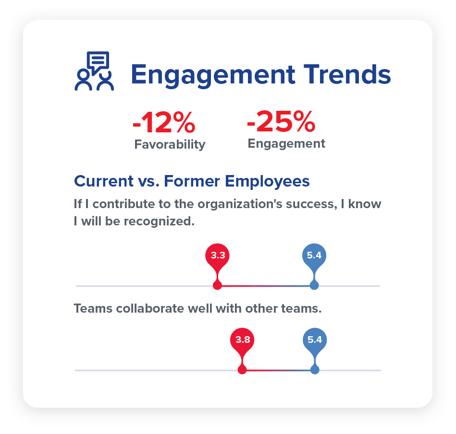
For example: Remaining employees were 86% favorable on the item, "If I contribute to the organization's success, I know I will be recognized," while termed employees were only 50% favorable. A 36-percentage point difference in favorability is a BIG deal.
Then, see if termed employees had high levels of uncertainty (where they said "somewhat agree" or "somewhat disagree") on particular items. Uncertainty leads to turnover. When employees aren't sure if you value their contributions, they're more likely to find a company that does.
Step 3: Take a Deeper Look at Different Populations
Retention opportunities may differ from population to population. Take your analysis one step deeper by analyzing engagement and exit data by employee demographics.
For example, the biggest gaps in favorability among termed and remaining millennials might be around employee development and career growth, while the difference in favorability between termed and remaining baby boomers in the same category was almost non-existent.
That tells you that career pathing might be a more effective employee retention strategy for millennials than baby boomers.
By analyzing your engagement and exit data among different demographics, you'll be able to implement tailored employee engagement strategies that actually work.
Step 4: Educate Leaders, Managers, and Supervisors
As much as HR likes to be involved in organizational engagement, managers and supervisors are really the ones on the front line. They often feel the pain and costs of turnover – time spent reworking schedules, managing around under staffing, and training new employees.
It is essential that managers and supervisors understand what drives retention because they are in the best position to better retain employees. Share any turnover trends you uncover with your team leaders and ask that they help you develop employee retention strategies.
Step 5: Customize Your Employee Retention Strategies
You understand the problems, you’ve equipped your troops, now it’s time to fight turnover. Put your employee retention strategies into place, and make clear that these initiatives are the result of engagement data, exit surveys, employee input, and manager effort.
This demonstrates that your organization listens to and values the employee voice — that's an employee retention strategy in itself!
Step 6: Determine If Your Retention Strategies Worked
In order to determine if your initiatives were successful, track related metrics like turnover and employee engagement. This is where we close the loop: next time you administer the survey, look for improvements. First and foremost, has turnover decreased? Is the overall turnover rate down?
Next, did the favorability gaps you identified (and created employee retention strategies to address) in Step 2 and Step 3 shrink? Did the favorability of termed and remaining employees increase on the categories where you created plans? Did turnover decrease among different demographics?
Employee retention surveys are key to alleviate your turnover problems in the modern workplace. And leveraging an effective survey partner can streamline your initiatives. With the right technology, you can implement your surveys in no time and continue to administer them at a regular cadence. The data can be spliced and diced to uncover deeper trends and understand the employee perceptions that matter. Effective survey technology can make all the difference toward driving essential employee, team, and business outcomes.
Quantum Workplace makes it easy to predict & prevent turnover
You need to take a targeted approach to analyzing turnover and retention. To move from reacting to turnover to proactively addressing it, you have to understand what drives top talent to leave—and continuously implement strategies to retain your best employees.
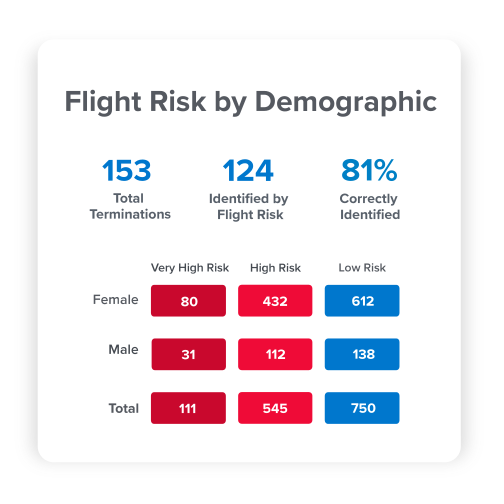
We make it easy to pinpoint trouble spots before they lead to turnover.Our employee flight risk analytics take the guesswork out of turnover. Identify employees with high retention risk and take action to prevent unwanted turnover. |
|
|
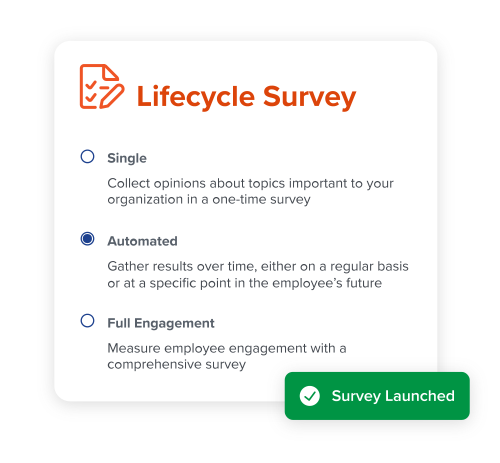
We make it easy to understand why employees are leaving.Understand retention obstacles and opportunities across the employee journey with employee lifecycle surveys. Optimize the employee experience and reduce the likelihood of disengagement at each stage. |
We make it easy to understand gaps in engagement.You should be actively seeking to understand the gaps that exist in engagement between current and former employees. Our Turnover Comparisons tool helps you uncover engagement obstacles and opportunities to strengthen your employee retention strategy. |
|
|
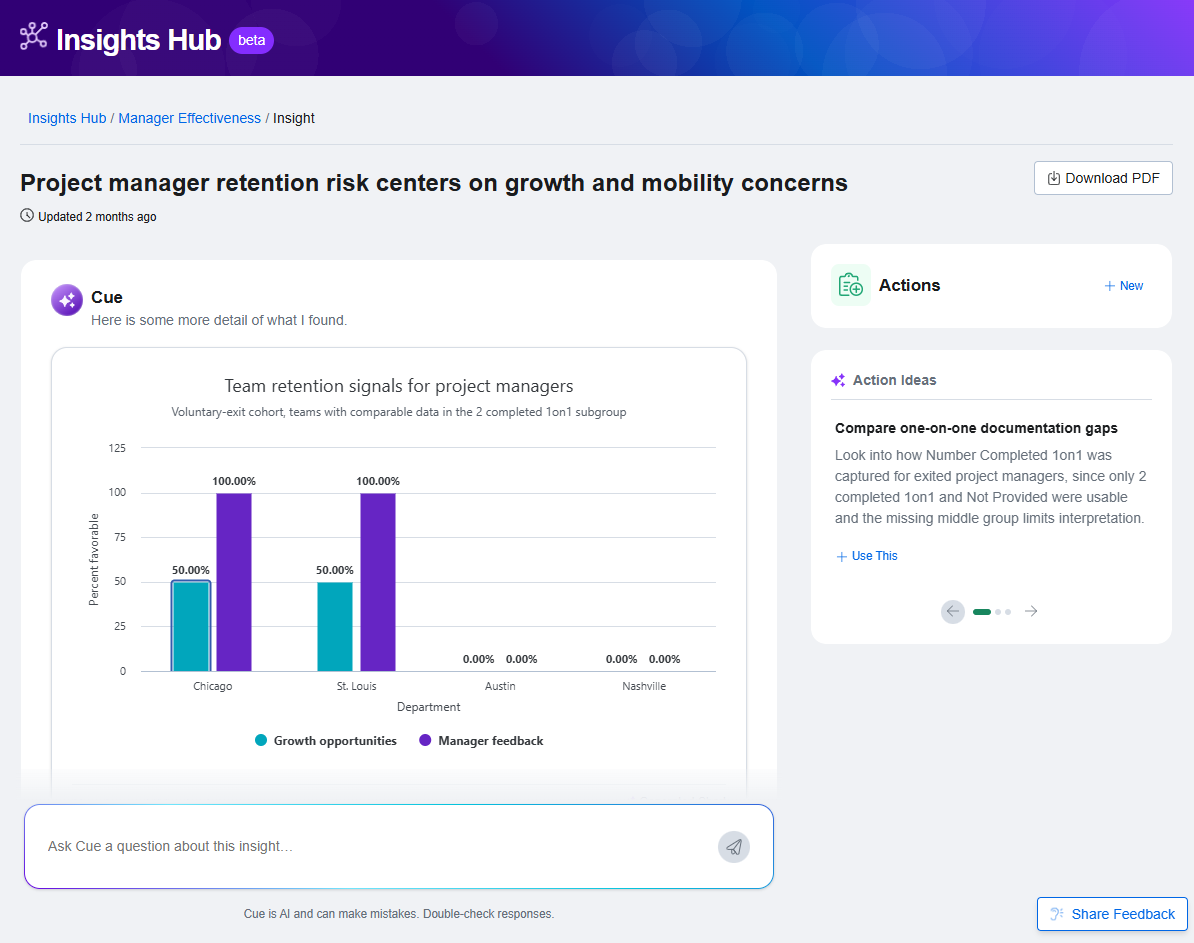
We make it easy to see who you're actually losing, not just how many.Total attrition numbers can hide the real story. Insights Hub connects your survey, performance, and talent review data to show whether the people leaving are your top performers or your lowest — two managers can have nearly identical turnover rates, but one may be quietly losing their best people while the other is losing the right ones. By layering in survey signals like intent to stay, Insights Hub validates the pattern and explains why it's happening, then flags concrete next steps (and any data gaps, like incomplete exit surveys) so HR and leaders can act on the real risk instead of the surface-level metric. |
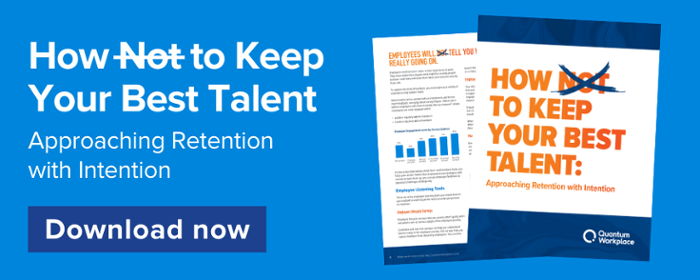
See how Quantum Workplace can help you retain top talent. Or download our ebook on approaching retention with intention!
FAQs
What is the difference between an employee retention survey and an engagement survey?
A retention survey focuses specifically on intent to stay and the workplace factors that influence turnover risk. An engagement survey measures employees’ broader connection to the organization, team, and work. The two should work together because disengagement can contribute to turnover, but not every engagement issue creates immediate retention risk.
How often should employee retention surveys be conducted?
Use a comprehensive retention diagnostic at least annually and add targeted pulse surveys when turnover risk changes, after major organizational changes, or when specific teams show retention concerns. Avoid surveying more often than the organization can review results and take visible action.
What are the best employee retention survey questions?
The best questions combine direct intent-to-stay items with diagnostic questions about growth, manager support, recognition, fair pay, wellbeing, resources, communication, and alignment. Open-ended questions should be added to explain why employees answered the way they did.
What is a stay interview and how is it different from a retention survey?
A stay interview is a one-to-one conversation with a current employee about what keeps them at the organization and what could cause them to leave. A retention survey collects comparable feedback at scale. Use survey data to identify patterns and stay interviews to explore those patterns in more depth.
How do you score an employee retention questionnaire?
Score scaled survey items consistently, calculate favorability or average scores by item, and compare results across relevant employee populations. The most useful analysis combines item scores with actual turnover data to identify which perceptions consistently differ between employees who stay and employees who leave.
What should HR do after an employee retention survey?
Identify the strongest retention-risk signals, segment the findings, involve managers in interpreting team-level patterns, choose a small number of actions, communicate those actions to employees, and measure whether perceptions and turnover improve over time.