

.webp?width=500&height=281&name=Employee%20Engagement%20Trends%202026%20(4).webp)

Self-reviews can be hard to write. You sit down to summarize a year of work, and everything you did shrinks into “I worked well with my team.” Your manager reads that line and learns nothing.
A strong self-review gives your manager what they couldn’t see for themselves: the context behind your work, the results it produced, and where you want to grow. A specific example does the job. It names what you did, what changed because of it, and what you’d change next time.
This blog shows you how to write a self-evaluation that is specific and balanced. You’ll find 59 examples to adapt for strengths, accomplishments, and areas for improvement across roles and skills.
What Is a Self-Performance Review?
A self-performance review is a written reflection where you assess your own contributions, strengths, and growth areas over a set period. Most employees complete one before a formal review with their manager.
A manager’s review gives their view of your work. Yours gives your view, plus context your manager may have missed. You don’t need to sound perfect. You need to connect your work to results, impact, and growth.
Most self-reviews ask you to cover:
- Your biggest accomplishments
- Progress toward your goals
- Strengths and skills you’ve demonstrated
- Challenges you faced
- Areas where you could improve
- New skills you’ve developed
- Goals for the next review period
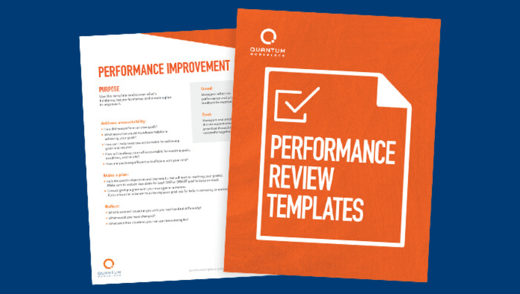
Quantum Workplace offers a self-assessment template that prompts you to reflect on your performance, areas for improvement, barriers, goals, and ways to measure progress.
You may see this process called a self-assessment, self-evaluation, self-appraisal, or self-performance review. The terms vary. Each one asks you to reflect on your own performance and development.
Benefits of a Self-Performance Review
A self-review helps both sides of the conversation. It also makes the performance review more complete.
Benefits for the employee
A self-review gives you the chance to:
- Reflect on your accomplishments and the impact you created
- Identify areas for improvement
- Prepare for the conversation with your manager
- Take ownership of your development
- Build a record that supports recognition and career growth
Benefits for the employer
A self-review gives employers the chance to:
- Surface work that never reaches a project update, like a teammate helping a colleague hit a deadline, an employee solving a recurring customer problem, or a new hire taking on a task nobody assigned
- Give managers a fuller picture before the review conversation, so the discussion rests on evidence from both sides and not only what the manager happened to see
- Turn a one-sided review into a dialogue, since employees who have reflected on their performance arrive with specific examples and ideas for growth
- Support employee engagement and improve the feedback that flows in both directions
- Show HR where employees need development support and where teams need more feedback or recognition, through self-evaluation data across the organization
4 Ways to Write an Effective Self-Evaluation
You know why self-reviews matter. Writing one that does them justice is the harder part. Before you open a template, do these four things.
1) Pull your actual work
Go back through your calendar, project management tools, and email. Add your recognition history if you have one. Look for what you delivered, the problems you solved, and the times you took initiative. Start with evidence, not impressions.
2) Be specific, without shrinking or inflating your role
“I contributed to the team” tells your manager nothing. “I led the Q2 onboarding redesign that reduced time-to-productivity from 60 days to 45 days” tells them what to weigh. The more specific you are, the more useful your self-review becomes.
3) Cover both sides
A self-evaluation that lists only strengths reads as defensive or unaware. Name a real area for growth and describe what you’re doing about it. Managers want to develop that kind of self-awareness on their teams, and it takes some courage to name a shortcoming.
4) Connect your work to outcomes
Anyone can list what they did. Employees who stand out explain why it mattered. Ask yourself what changed because of the work, who benefited, and what would have happened without it.
Self-Performance Review Examples by Focus Area
The examples below put those principles to work. They cover the areas that come up most in self-reviews, with strengths and improvement examples for each.
Growth and Development Examples
Growth is easy to put off when deadlines pile up. These examples show how to name what you learned and what you plan to learn next.
Strengths
1. “I completed [certification/course] at the start of the year and applied it to [project] right away. I can see a clear difference in how I approach [skill area] compared to six months ago.”2. “I spotted a gap in my knowledge of [area] early in the year and didn’t wait for training to be assigned. I found a resource, worked through it, and was applying it in real work by Q3.”
3. “I took on [stretch assignment] even though it sat outside my comfort zone. It pushed me in ways a familiar project wouldn’t have, and I’m still using the skills I built.”
Areas for improvement
4. “I tend to build new skills when a project demands them instead of investing in development ahead of time. Next cycle, I’ll set aside dedicated learning time each month.”
5. “I left professional development resources unused this year. I put delivery ahead of growth. That trade-off worked in the short term, and I don’t want to keep making it.”
Accountability Examples
Owning a mistake takes courage. These examples show how to do it with a clear fix attached.
Strengths
6. “A process failure hit [area], and I didn’t wait for someone to ask. I took ownership, traced it to the root cause, and put a fix in place within 30 days. It hasn’t happened again.”7. “When something goes wrong on my side, I name it, explain what I learned, and move on. I haven’t let an error go unaddressed this year."
Areas for improvement
8. “I underestimated the scope of [project], and the timeline slipped. I should have asked more questions up front. Before I commit to a deadline from now on, I’ll scope the work first.”
9. “I haven’t documented outcomes after finishing a project. I’ll make that a standard step in how I close out work, so the record exists when I need it.”
Leadership Examples
You don’t need a manager title to lead. These examples work for anyone who guided a project, a teammate, or a change.
Strengths
10 “I led [project] from planning through delivery and coordinated across [number] teams. We hit our deadline, and the outcome was [result].”11 “I mentored [colleague] through [situation] this year. They now handle [responsibility] on their own. I’m prouder of that outcome than of anything else I did this year.”
12 “I pushed for a change in [process/approach] that I believed in, even though people resisted. The team made the change, and [outcome] followed.”
Areas for improvement
13 “I gave my peers positive feedback this year and avoided the harder conversations. I want to build the confidence to give honest, specific feedback, even when it’s uncomfortable.”
Communication Examples
Good communication goes unnoticed until it breaks down. These examples help you show the habits that prevent that.
Strengths
14 “I started sending a written project update every Thursday that covers progress, blockers, and next steps. I now get far fewer clarification questions.”15 “I adjust my communication style to my audience: more detail for technical stakeholders, more context for leadership. People receive my work better because of it.”
16 “I spotted a miscommunication risk in [project], raised it early, and helped the right people align before it became a problem.”
17 “I led two cross-team sessions this year and shared written summaries within 24 hours of each one. People told me the follow-through made the next steps much clearer.”
Areas for improvement
18 “I take too long to answer non-urgent messages, and it has created friction for people waiting on my input. I’m building a more reliable response rhythm.”19“I sometimes give more detail than the other person needs. I want to get better at reading how much context a conversation calls for.”
20 “I’m more confident writing than speaking to large groups. I want to take on more chances to present and contribute out loud, because practice is the only way to build that skill.”
Collaboration and Teamwork Examples
Teamwork often happens out of your manager’s sight. These examples put it on the record.
Strengths
21 “[Colleague/team] needed extra capacity during [situation], and I stepped in without being asked. We delivered on time.”22 “People on other teams tell me I’m easy to work with and that they trust me to follow through. I take that to heart, and I’ve worked to build it.”
Areas for improvement
23 “I tend to work on my own and don’t always loop teammates in early enough. That has led to duplicated work. I want to share context earlier as a regular habit.”24 “I can get defensive when someone questions my approach. I know it, and I’m learning to treat feedback as information instead of criticism.”
25 “I collaborated within my own team this year. Next cycle, I want to build cross-functional relationships that strengthen my work and my development.”
Quality of Work and Productivity Examples
Numbers make these examples land. Swap in your own wherever you can.
Strengths
26 “I added a personal review step before submitting work this year. Revision requests have dropped by 20 to 25% since I started.”27 “During [high-pressure period], my output stayed consistent. I balanced competing demands and held the quality of my work.”
Areas for improvement
28 “My output was inconsistent in Q2. I was juggling competing priorities and didn’t set or communicate them clearly enough. The work suffered.”29 “I want to protect focused work time better. Frequent meetings and non-urgent requests have taken too much of it.”
Skills and Competencies Examples
Strengths
30 “I built solid proficiency in [tool/skill] this year and applied it to [project]. The outcome was [result]. I documented my approach so others can use it too.”31 “My analytical thinking has sharpened this year. I’m more comfortable drawing conclusions from data and presenting them to the people who need to act on them.”
Areas for improvement
32 “I know I need to build skills in [area], and I haven’t made time for it. Time has been the barrier. For next cycle, I’ll build a development plan that fits my actual workload.”33 “I’m behind most of my peers on [tool/technology], and it has created friction in shared work. I have a concrete plan to close that gap in Q2.”
Problem-Solving Examples
Strengths
34 “[Unexpected situation] hit mid-project. I weighed the options and made a recommendation that kept us moving without a major delay.”35 “I submitted [number] documented improvement ideas this year, each with a rationale and an estimated impact. [Number] were approved and are now in use.”
36 “I bring at least one proposed approach with every problem I take to my manager. I’ve kept that habit all year.”
Areas for improvement
37 “I try to solve problems on my own for too long. By the time I escalate, the issue is sometimes bigger than it needed to be. I’m learning to spot sooner when something needs more than one person.”38 “My problem-solving tends to run in a straight line. I commit to the first workable option and skip the alternatives. I want to get more comfortable with ambiguity and stay in it longer.”
Initiative and Proactivity Examples
Strengths
39 “I spotted a gap in [process/area] that no one had flagged, built a proposal, and brought it to my manager unprompted. My manager approved it, and the team uses it now.”40 “I volunteered for [project/responsibility] before anyone assigned it. We started sooner than we would have otherwise.”
Areas for improvement
41 “I respond well when problems come to me. I’m weaker at anticipating and preventing them. Next cycle, I want to build a more forward-looking instinct.”42 “I played it safe with stretch opportunities this year and said no more often than I should have. Next cycle, I want to say yes to at least one thing that makes me uncomfortable.”
Self-Evaluation Examples for Specific Roles
Success looks different from role to role. The foundation stays the same, but a manager, a customer-facing employee, and a remote employee each show strong performance in their own way.
Self-Evaluation Examples for Managers
Strengths
43 “I gave my team clearer priorities and set up regular time to discuss progress and challenges.”44 “I gave feedback more often instead of saving it for the formal review period.”
45 “I helped team members find development opportunities that fit their goals and the team’s needs."
Areas for improvement
46 “I want to delegate more so I can spend more time training and developing my team.”47 “I want to recognize contributions more often so good work doesn’t go unnoticed.”
48 “I want to get more comfortable giving difficult feedback earlier.”
Quantum Workplace research found that more than 2 in 3 employees say feedback from their managers is vital to improving their performance. Regular feedback supports your team’s growth all year, so don’t save it for the formal review.
Self-Evaluation Examples for Customer-Facing Roles
Strengths
49 “I stayed professional and solution-focused through difficult customer conversations.”50 “I followed up after resolving customer issues to confirm the problem was resolved.”
51 “I looked for ways to understand customer needs instead of stopping at the immediate request.”
Areas for improvement
52 “I want to improve my product knowledge so I can resolve more questions on my own.”53 “I want to balance speed and quality better when I handle a high volume of customer requests.”
Self-Evaluation Examples for Remote or Hybrid Employees
Strengths
54 “I shared project updates before anyone asked, so teammates had visibility even when we weren’t in the same location.”55 “I used shared tools and documentation to keep work moving without constant meetings.”
56 “I managed my schedule well and stayed available when teammates needed to collaborate.”
Areas for improvement
57 “I want to build relationships with colleagues I don’t interact with often.”
58 “I need to communicate my availability and response times more clearly when I work remotely.”
59 “I want to speak up more in virtual meetings instead of relying on written follow-ups.”
5 Steps to Use These Examples in Your Self-Performance Review
Treat these examples as starting points. Adapt each one to your own work, results, and growth areas.
Step 1: Pick the categories that matter most for your role. Choose three to five areas that cover the biggest parts of your contribution.
Step 2: Replace the placeholders with your specifics. Turn every bracket, such as [project], [outcome], and [metric], into something real from your year. If you can’t fill in the blank, the example doesn’t fit you.
Step 3: Balance strengths and growth areas. Give both equal weight. A review with only strengths reads as unaware. A review with only improvement areas reads as unconfident.
Step 4: Match your tense to the story. Write “I did this” for completed work and “I’m working on this” for ongoing development.
Step 5: End with a look ahead. Say what you want to accomplish next cycle and what support you need. A forward-looking close gives your manager something to respond to, not just evaluate.
Use Your Recognition History to Write a Stronger Self-Review
Remembering a full year of work is one of the hardest parts of a self-review. Your recognition history gives you a head start.
Peer shoutouts, manager acknowledgments, client compliments, and milestone celebrations add up to a searchable record of your year. Skip the blank-page question “What did I do this year?” and look back at the moments when someone named your contribution.
For example:
Recognition: “Thanks for stepping in and helping the team get the client presentation ready.”
Self-review evidence: “I stepped in during a tight deadline to help finalize the client presentation, which let the team deliver on schedule.”
Common Mistakes to Avoid in Your Self-Evaluation
1) Shrinking your contributions. A self-review is no place to downplay your work. If you led something, say you led it. If the outcome was measurable, name the number.
2) Staying vague. “I was a strong collaborator this year” proves nothing. “I covered for [colleague] during their leave and delivered [outcome] on time” proves it.
3) Writing only about the past. The best self-reviews close with goals for the next cycle, development areas, and the support you need from your manager. Give the conversation somewhere to go.
4) Waiting for the deadline. Note a win after it happens and capture feedback while it’s fresh. A review written from memory at the deadline comes out weaker.
5) Skipping your recognition history. If your organization uses a recognition platform, your shoutouts from the past year are some of your best source material. They show what your colleagues valued, and that often differs from what you would have chosen to highlight.
How Quantum Workplace Turns a Year of Recognition into Self-Review Evidence
Every shoutout you receive during the year is a record of work someone noticed. Quantum Workplace keeps that record where you can find it.
Here is how it works. A coworker or manager clicks Give Recognition, picks you as the recipient, adds context about what you did, and chooses a badge. They can also link the post to one of your goals. You get an in-app and email notification, and the post appears in the Activity Feed on your company’s homepage. Teammates can comment on it and react with emojis.
Review season arrives, and you open the Recognition homepage. The search options let you filter by keyword, person, date range, or badge. Type your own name in the person field to see every post you gave or received. Narrow the date range to your review period, then read through the posts. Each one names a specific contribution in a colleague’s words.
Copy those details into your self-review. A post that says “Thanks for staying late to get the client deck ready” becomes “I stepped in on a tight deadline to finish the client deck, and the team delivered on schedule.” Your evidence comes from the people who saw the work, not from memory.
Peers see what managers miss, including the collaboration, the behind-the-scenes support, and the quiet initiative that never reaches a project status update. Recognition posts put that work on the record, so your self-review tells a fuller story than your manager’s version alone.
Managers have a tool for this too. Admins and managers can export recognition from the Recognition area as a PDF report or an XLS file that includes provider and recipient details, comments, and reactions. Use it to review your team’s year before you write their reviews.
FAQs
What is a self-performance review? A self-performance review is a written reflection where you evaluate your own contributions, strengths, and development areas over a set period, often before a formal review with your manager. It gives managers context they would otherwise lack and gives you a voice in how your performance is understood.
How do you write a self-evaluation? Start by pulling your actual work: your calendar, project records, and recognition history. Focus on specific contributions and measurable outcomes, not general statements. Cover strengths and areas for improvement, connect your work to outcomes, and end with what you want to accomplish next.
What are good self-appraisal comments by an employee? Good comments are specific, honest, and focused on outcomes. They name what you did, explain why it mattered, and acknowledge where you fell short without excessive self-criticism. “I led the Q2 onboarding redesign that reduced time-to-productivity from 60 days to 45 days” is a strong example. “I was a team player this year” is not.
What are some staff self-evaluation examples? A staff self-evaluation sample shows how an employee describes accomplishments, challenges, strengths, and areas for improvement. For example: “I delivered [X] of [Y] projects on time this year. Where timelines slipped, I flagged the risk early and proposed a revised plan.”
What should I include when writing a performance review for myself? Cover the areas most relevant to your role: delivery and quality of work, collaboration, communication, growth and development, and any goals you set at the start of the cycle. Use specific examples with outcomes. Skip phrases anyone could have written. End with what you want to accomplish next cycle.
How does Quantum Workplace help with self-evaluations? Quantum Workplace captures peer recognition, manager acknowledgments, and milestone celebrations in real time through Slack and Microsoft Teams. Review season arrives, and you have a searchable recognition history to draw from instead of relying on memory.
What are some examples of writing a performance review for yourself? Focus on specific accomplishments, results, challenges, and areas for growth. For example: “I led the Q2 onboarding redesign, which reduced time-to-productivity from 60 days to 45 days. I also found communication gaps in the process and plan to address them next cycle.”