

.webp?width=500&height=281&name=Employee%20Engagement%20Trends%202026%20(4).webp)
.webp)
Updated February 11, 2026
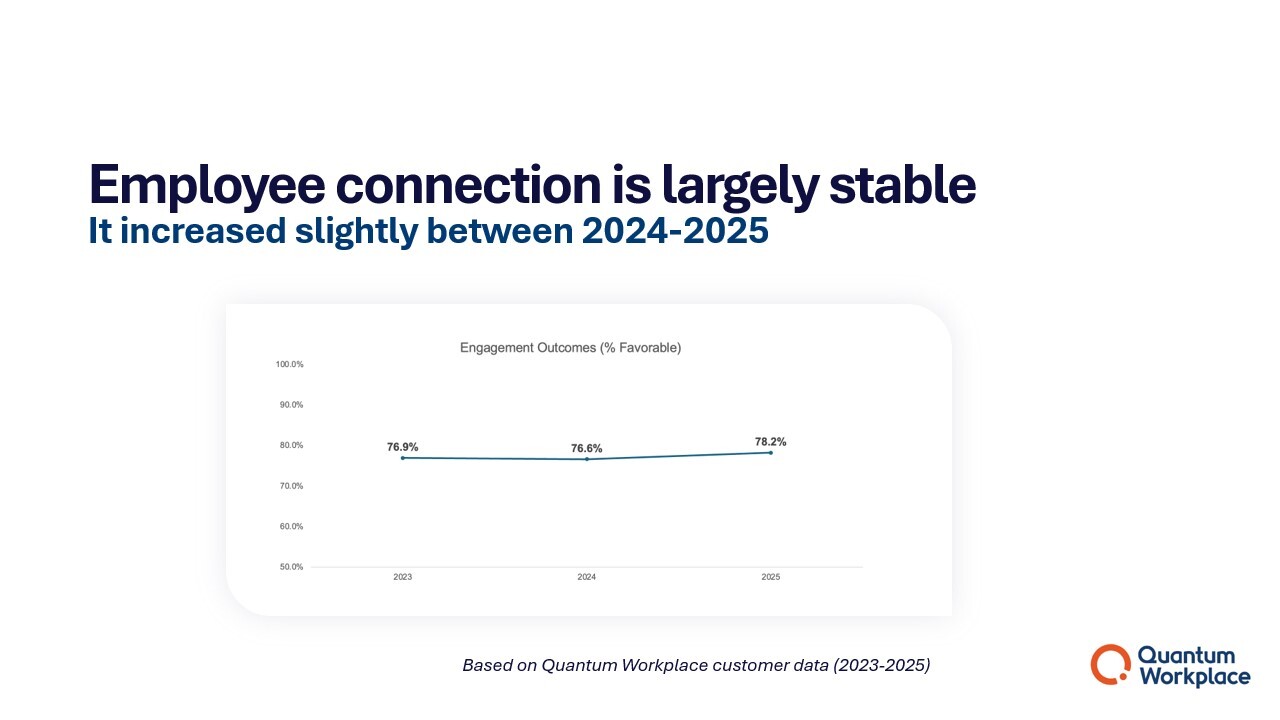
Engagement is steady. Turnover is at a record low. On paper, employee engagement trends in 2026 suggest everything is just fine.
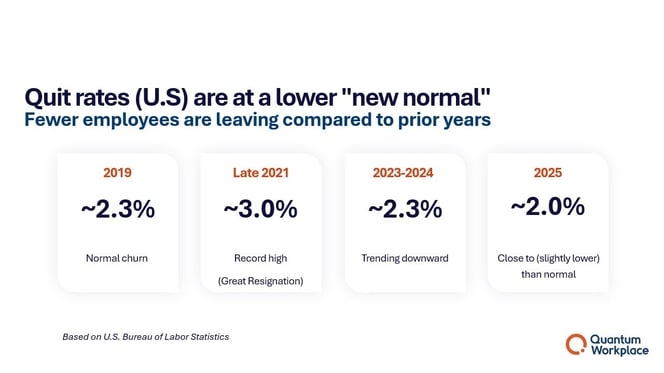
Across industries, U.S. quit rates fell to roughly 2.0% in 2025, the lowest level in years. Engagement scores have remained largely stable as well— reinforcing the perception that organizations are in a healthy place.
But today’s workplace context tells a more complicated story.
Talent movement is low. Pressure and expectations inside organizations are high. And constant change—from restructuring to new ways of working and emerging technologies—has become the norm. In this environment, stable engagement scores and low quit rates can create an illusion of stability.
“Steady employee engagement may reflect resilience, not progress,” says Aaron Brown, Senior Manager of People Insights at Quantum Workplace. “Many organizations mistake stability for strength and miss opportunities to move forward.”
Low quit rates don’t always signal stronger connection, either.
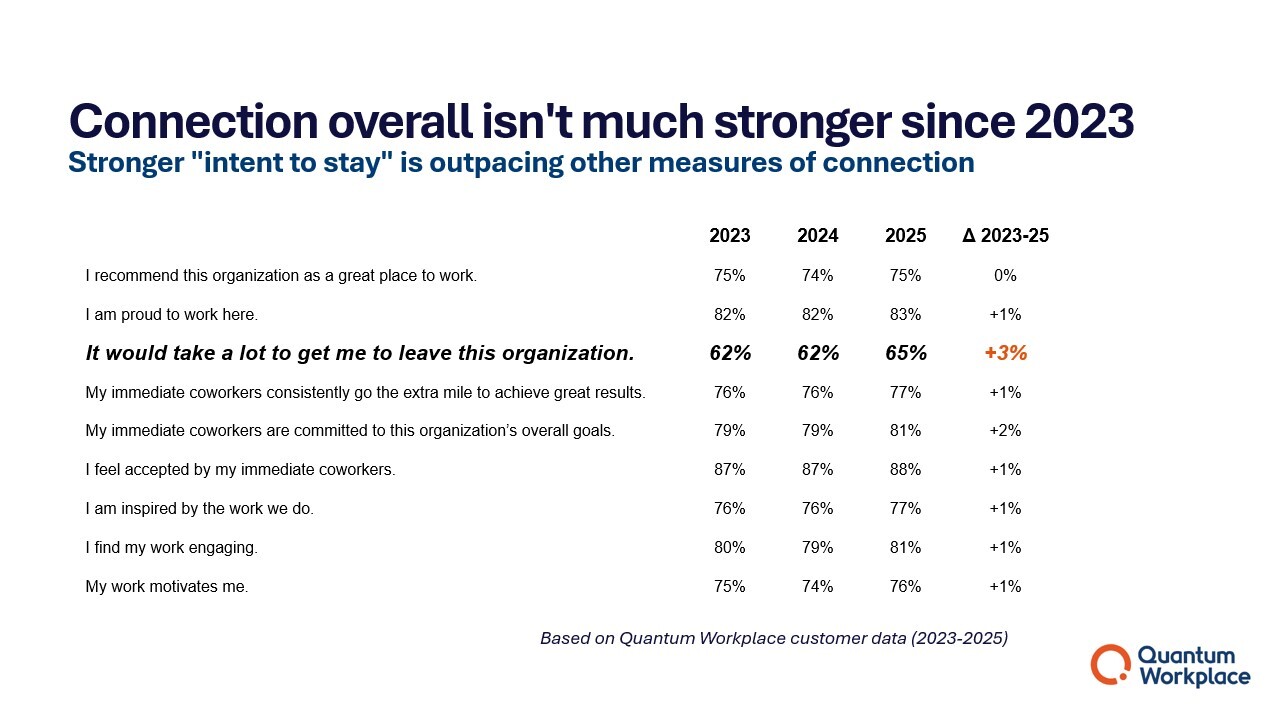
Quantum Workplace data shows that intent to stay is rising faster than other engagement measures — suggesting many employees are staying because it doesn’t feel like the right time to leave, not because they feel energized, aligned, or set up to grow.
Anne Maltese, VP of People Insights, refers to this as latent risk: a workforce that appears engaged on the surface, but isn’t fully prepared to move forward.
That’s why high-level engagement and turnover metrics aren’t enough on their own.
Below, we break down four employee engagement trends in 2026 that reveal what headline metrics can miss — and the deeper signals HR leaders need to understand whether their teams are truly thriving or quietly being held back.
Watch our People Insights experts
unpack these trends in our AMA session.
.png?width=500&height=500&name=Thriving%20or%20Held%20Back%20AMA%20with%20Quantum%20Workplace%20(3).png)
Key takeaways
- Stable engagement and turnover can hide opportunity: Organizations may look healthy while underlying energy, focus, and growth stall.
- Intent to stay is outpacing engagement: Employees are remaining in place, but not necessarily feeling inspired, aligned, or enabled to grow.
- Manager capability is an early signal: Pressure on managers can quickly erode clarity, confidence, and connection across teams.
- Top performers are paying attention: When accountability and advancement lag, high achievers are often the first to disengage.
- Deeper signals matter more than surface metrics: Understanding why people stay — and how they’re growing — is essential to sustaining performance.
4 employee engagement trends to watch in 2026
Employee engagement in 2026 is shifting from measurement to meaning.
While retention and engagement metrics appear strong, Quantum Workplace data shows that deeper signals—like manager capacity, alignment, and connection—reveal where teams are truly positioned to thrive.
These four employee engagement trends highlight what HR leaders need to watch to move beyond stability and build sustained performance in the year ahead.
Trend 1: Managers are one of the first places where pressure shows up
Key trend
Managers are under mounting pressure to deliver results, coach teams, and execute constant change — often with limited time, clarity, or support.
Why it matters
When expectations outpace clarity and support, managers are often the first group to show declining engagement, recognition, and confidence — creating early risk that spreads quickly to their teams.
What the data shows
Across organizations, managers frequently score lower than both executives and frontline employees on engagement, recognition, and clarity around expectations.
Implication for 2026
Manager experience is becoming a leading indicator of organizational alignment. When clarity breaks down at this level, misalignment scales faster than engagement or turnover metrics reveal.
Action insight
Look beyond whether managers hold 1:1s—evaluate how effective those conversations are at creating clarity, alignment, and focus.
A deeper look at the data
When we've examined manager experience data from our customers more closely, we've seen these patterns:
- Risk shows up first at the manager level.
Middle managers and some senior leaders often score lower than both executives and frontline employees on engagement, recognition, and clarity—making manager experience an early warning signal.
- The greatest risk isn’t always at the front line.
Directors, senior directors, and VPs frequently surface the strongest risk signals, revealing gaps in alignment and support just below the executive layer. - Clarity breaks down before results do.
Managers are less likely to strongly agree that they understand how their performance is measured or what’s expected of them. When clarity erodes here, misalignment cascades quickly to the teams they lead.
Together, these signals show that manager experience is one of the most critical places to intervene before engagement and turnover metrics shift.


Case Study: Bridging the feedback gap: a modern leadership lesson
When one large enterprise dug into its leadership coaching data, it uncovered a hidden opportunity: the higher the position, the better the feedback. Managers deeper in the organization weren’t receiving the same developmental input, revealing a feedback gap that quietly limited performance growth.
The company’s response was simple but powerful—coach the coaches. By training leaders to give constructive, growth‑oriented feedback, they shifted focus from how often 1:1s occurred to how valuable those conversations were.
The takeaway: frequency doesn’t equal effectiveness. Examining how feedback really happens exposes missed opportunities to strengthen connection, performance, and change readiness at every level.
8 questions to determine:
|
|
Trend 2: Top talent is paying attention — and signaling what they need to stay
Key trend
Top performers are actively signaling their experience through feedback, survey data, and talent reviews — even when engagement and turnover metrics appear stable.
Why it matters
When leaders overlook feedback from top performers, they miss early warning signs from the employees most critical to performance, continuity, and future leadership.
What the data shows
Development and coaching scores remain strong for top performers, while advancement, fairness, and accountability indicators consistently lag.
Implication for 2026
Retention risk among top talent is becoming quieter — and harder to detect. Frustration can build even when employees aren’t actively looking to leave.
Action insight
Segment engagement and feedback data by performance level or talent status to understand how high performers are really experiencing work — not just whether they’re staying.
A deeper look at the data
When we segment customer engagement data by performance and talent status, we see patterns like:
- Top performers feel supported — but not always treated fairly.
High performers score well on development and coaching items, yet advancement and fairness indicators lag behind. Trust in fairness has been among the lowest-scoring items in recent data. - Frustration comes from accountability gaps, not disengagement.
Open-ended comments reveal that top performers are most frustrated when low performance is tolerated. Negative or critical feedback often comes from employees who care deeply and want the organization to improve — not from disengaged talent. - Retention risk hides behind stable metrics.
Talent reviews reinforce this pattern: “stretch and grow” employees often lack clear advancement paths despite strong performance. While they may not be actively looking to leave, many are quietly questioning their future.
💡 Together, these signals show that stable engagement and turnover metrics can mask growing frustration among the employees organizations most want to retain.


When engagement and turnover look stable, how can HR leaders avoid assuming talent is fine?
 “The first thing I want to know is: how do my top performers feel? You can use surveys, one-on-ones, focus groups — it’s not necessarily more data. It’s being intentional about how you look at the data you already have.”
— Anne Maltese, VP of People Insights
9 questions to determine:
|
|
Trend 3: Urgency without focus is making productivity harder than it needs to be
Key trend
Teams are working hard, but unclear priorities and competing goals make it harder for effort to translate into meaningful impact.
Why it matters
Unchecked urgency leads to fatigue and confusion. When priorities shift faster than clarity and communication, collaboration breaks down and employees lose sight of what actually drives results.
What the data shows
Misalignment is widespread — even among top performers. Roughly 25% don’t clearly understand organizational priorities, and written goals are significantly more common among high performers.
Implication for 2026
Without sharper focus and alignment, organizations risk sustained effort with diminishing returns — more activity, less impact.
Action insight
Strengthen goal clarity by ensuring priorities are written, connected to strategy, and reinforced through one-on-ones, feedback, and recognition.
A deeper look at the data
When we examine customer alignment and goal data more closely, we see patterns like:
- Employees trust the organization — but lack line-of-sight to success.
Many employees believe the organization will succeed, yet don’t understand how their work contributes to strategic priorities — a hidden source of inefficiency and disengagement. - Too many goals dilute focus, even for high performers.
Teams often juggle competing priorities, and even among top performers, roughly one-quarter don’t clearly understand organizational priorities — leaving meaningful productivity on the table. - Clarity, not effort, separates performance levels.
Written goals strongly correlate with performance: 89% of top performers have goals documented, compared to 78% of employees needing improvement. Once goals are written, one-on-ones and feedback become more focused, enabling better insight and action.
💡 Together, these signals show that productivity challenges are rarely about effort — they stem from misalignment, unclear priorities, and lack of focus.


What does misalignment actually look like inside teams, and how does it show up before results start to slip?
“It starts with good intentions, but that’s usually where misalignment starts to show up. The clearest example is how organizations have approached AI. It’s wonderful. It’s an amazing tool. But we’re hearing from customers and employee feedback that they’re being told, “Just try it out, see what you can do.” Now add: “Learn a new technology.”
 Combine that with “do more with less,” and it shows up as good intention but no clear, defined goal—what are we trying to accomplish, and how are we going to support people to accomplish it? If we can solve that, people will feel more excited to try new ventures.”
— Aaron Brown, Senior Manager, Insights
5 questions to determine:
|
|
Trend 4: Future-ready in intent, uneven in execution
Key trend
Many organizations can identify successors and critical roles, but preparation, readiness, and retention aren’t keeping pace — creating a gap between who’s named and who’s truly ready.
Why it matters
When future leaders and high-tenured employees feel stalled, burned out, or undervalued, organizations become fragile — even when engagement and retention metrics appear strong.
What the data shows
Succession candidates, senior leaders, and long-tenured employees often surface early risk signals, including burnout, uneven development, and readiness gaps that aren’t visible in headline metrics.
Implication for 2026
Future readiness depends not just on identifying successors, but on intentionally developing them, supporting their well-being, and reducing over-reliance on a small number of leaders.
Action insight
Connect succession, development, engagement, and tenure data to identify readiness gaps early, address burnout risk, and ensure future leaders are both prepared — and willing — to step forward.
A deeper look at the data
When we examine future-readiness signals in customer data more closely, we see trends like:
- Successors are identified, but not fully prepared.
Many organizations can name future leaders, yet lack clear, intentional development plans that prepare those individuals for what’s next — creating a gap between potential and readiness. - Retention risk among future leaders stays hidden until conditions change.
Succession candidates and high-potential employees may appear stable, but retention risk rises quickly when growth stalls or the labor market shifts. - Burnout and over-reliance at the top create hidden vulnerability.
Senior leaders and executives can show elevated burnout risk even in otherwise healthy organizations. When too much momentum rests on a few individuals, losing one critical leader can derail progress.
💡 Together, these signals show that future readiness isn’t about stability alone — it requires intentional preparation, development, and protection of leadership capacity at every level.


Case Study: When “high engagement” hides leadership burnout
A compelling example of a client whose engagement scores painted a picture of success—yet behind the numbers, the executive team was running on empty:
At first glance, survey results suggested a thriving culture: employees felt connected, motivated, and loyal. But a deeper pulse check revealed another story—leaders were stretched thin, morale was slipping, and innovation had stalled. “High engagement at the surface can mask burnout underneath,” Aaron Brown explains.
This case underscores a key 2026 workplace insight: strong engagement metrics don’t always mean a healthy organization. When performance expectations rise faster than capacity or connection, energy eventually erodes. HR and leadership teams need to look beyond top‑line engagement scores to uncover early signals of fatigue, turnover risk, and unrealized potential.
6 questions to determine:
|
|
Turning employee engagement data into informed decisions
The four trends above point to a common reality: employee engagement data only creates value when it leads to clearer decisions and earlier action. In 2026, steady metrics aren’t the goal — informed insight is.
To move from stability to sustained thriving, HR leaders need to connect engagement data to performance, development, growth, recognition, and retention signals — and use those connections to guide action at every level.
Practical ways to act on these insights:
- Equip managers to translate data into action.
Give managers the tools and context to interpret engagement signals and use them in meaningful, team-level conversations. - Connect engagement with performance data.
Look beyond sentiment to understand how areas like motivation, workload, and goal alignment affect business outcomes. - Review signals regularly, not reactively.
Establish monthly or quarterly “signal reviews” to detect early shifts in connection and performance — before they show up as disengagement or turnover.
Organizations already applying this approach are seeing the difference. Quantum Workplace customers who connect engagement insights with performance and talent data are better positioned to retain top talent, strengthen manager effectiveness, and sustain momentum through change.
Take the step from steady engagement to thriving teams
Building thriving teams requires looking beyond engagement scores alone. Thriving doesn’t happen by chance — it happens when connection and performance are treated as inseparable, and leaders have the insight they need to act early and with confidence.
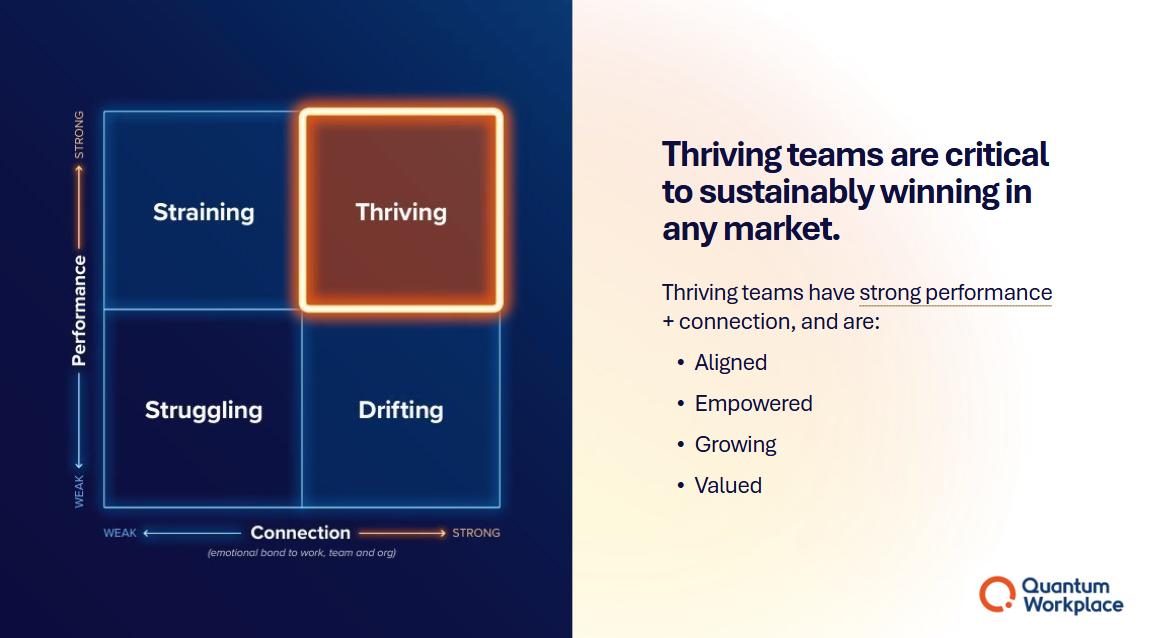
When connection exists without performance, teams drift.
When performance exists without connection, teams strain and burn out.
When both are weak, teams struggle.
But when both are strong, teams enter a powerful cycle: results improve retention, retention strengthens capability, and stronger capability fuels even better results.
To build that cycle, organizations must strengthen both connection and performance across four key conditions: alignment, empowerment, growth, and feeling valued. HR plays a critical role in reading the signals across these areas — and equipping managers to turn insight into action.
Final thoughts: employee engagement trends are the starting line
Healthy engagement metrics aren’t the finish line. They’re the starting point for strategic growth.
The goal isn’t to overhaul your talent strategy overnight — it’s to act on the opportunities hidden in plain sight. In this era, organizations need to:
- Understand their talent more deeply
- Identify risk and opportunity earlier
- Develop and grow existing employees
- Create clarity and alignment at every level
- Use better signals to understand whether teams are truly thriving
As Anne Maltese puts it:
“Focus on your knowns. You can’t control everything, but you can develop your top performers, nurture your successors, and prepare people now for what’s next.”