
.webp?width=500&height=281&name=Employee%20Engagement%20Trends%202026%20(4).webp)

It probably started with a Slack message. Someone on your leadership team asked why engagement scores dropped last quarter, or a manager admitted they hadn't done a real 1-on-1 in months, and suddenly "let's look at talent management systems" became a project on your plate.
Now you've got a spreadsheet with twelve vendor names on it, three demo calls booked, and a nagging feeling that you're still missing something. That feeling is fair. This isn't a tool you swap out every year. It shapes how every manager coaches, how every review gets written, and whether your best people feel seen enough to stay.
This guide walks through what a talent management system actually does, the criteria worth weighing before you sit through another demo, and how ten leading platforms compare, so you can build your vendor shortlist with confidence.
What Is a Talent Management System?
A talent management system helps organizations build better managers, identify top talent and keep your best people. Most platforms cover some combination of engagement, performance, development, and recognition. Instead of managing goals in one tool, reviews in another, and surveys in a third, a talent management system brings that data into one place. The goal is simple: give HR and managers a clear, connected view of how people are doing, not just a pile of disconnected reports.
What are the key features to look for in a Talent Management System?
Not every platform covers the same ground, and the right feature set depends on what your organization is trying to fix first. At a minimum, look for tools that support these core areas.
- Goal and performance tracking, including OKRs, check-ins, and manager visibility into progress
- Retention risk detection, using engagement and performance signals to flag flight risk before it becomes a resignation
- Continuous feedback, so employees get input more often than once or twice a year
- Structured performance reviews, with templates that fit your culture instead of forcing a generic format
- Employee engagement surveys, covering annual, pulse, action planning and lifecycle listening
- Recognition tools, so contributions get noticed in the flow of work, not buried in a spreadsheet
- Development and succession planning, to help employees grow and to protect your bench strength
- Manager-facing analytics, that turn raw data into clear next steps instead of static dashboards
- HRIS and SSO integrations, so the system fits into your existing tech stack instead of sitting apart from it
Key criteria to consider when choosing a Talent Management System
Ease of adoption. A powerful platform that managers avoid opening is not powerful. Look for a clean interface and a short learning curve, especially for the managers who will use it weekly.
Connected data, not siloed modules. Some platforms bundle engagement, performance, and development without truly connecting them. Ask vendors directly how data flows between modules, not just whether the modules exist.
Implementation and support. A system is only as good as the team behind it. Ask about onboarding timelines, training, and what happens when your HR team has a question six months after launch. Some vendors also offer dedicated insights or advisory teams as an add-on, giving you direct access to people-analytics experts who help you interpret your data and plan next steps.
Pricing structure. A low starting price doesn’t always tell the full story. Costs can change as your organization grows or you add capabilities like engagement, performance, and recognition. Compare what you’ll pay for the capabilities and employee count you expect to need over the next two years—not just what you need today.
Scalability. Choose a system built for where your organization is headed, not just where it stands today. Growing companies especially need a platform that will not require a full replacement in eighteen months.
Analyst and customer validation. Independent research, like Gartner's Magic Quadrant reports or Forrester Wave evaluations, offers a useful outside check on vendor claims.
5 benefits of a Talent Management System
1. Stronger manager effectiveness. Managers get context on their teams instead of relying on memory or gut feel. They can see goals, feedback, recognition, and engagement trends before a 1-on-1 even starts. That makes coaching conversations more specific and more useful. Employees feel heard, and managers walk away knowing exactly what to follow up on.
2. Fewer blind spots on retention risk. Connected engagement and performance data surfaces flight risk earlier. A drop in survey sentiment means more when you can see it next to performance trends and recent recognition. You can act before a resignation letter forces the conversation. Leaders can focus retention efforts on the teams and top performers who need them most.
3. Less administrative burden on HR teams. Automated review cycles, survey scheduling, and reporting free up time HR teams used to spend chasing spreadsheets. Many platforms are also building AI directly into these workflows now, drafting review summaries, suggesting action steps, and surfacing patterns in feedback, so HR spends less time compiling data and more time acting on it.
4. Better succession planning. Your senior people hold knowledge that keeps the business running. When they leave without a plan, that knowledge often leaves with them. A talent management system turns succession into a structured process. You can see bench strength at a glance, meaning who is ready and willing to step up. You can match skills to open roles and spot where gaps will show up next. That gives you time to prepare, not scramble.
5. AI-driven decision making. Gut feel only takes a leader so far. Centralized dashboards give you a clear read on how your people are really doing. AI-powered insights go a step further. They connect signals across surveys, 1-on-1s, and performance reviews to surface patterns a person would likely miss. A team can look healthy on engagement and still be losing top performers. AI can spot that gap, explain where it came from, and suggest a next step. Leaders spend less time digging through reports and more time acting on what matters.
Talent Management vs HRIS
|
|
HRIS |
Talent management system |
|
Primary purpose |
Store and administer employee records |
Develop, engage, and retain employees |
|
Core data |
Payroll, benefits, time off, compliance |
Goals, feedback, reviews, engagement, recognition |
|
Main users |
HR administrators |
Managers and employees, every day |
|
Update frequency |
Changes when life or employment events happen |
Updated continuously, through check-ins and feedback |
|
Typical question it answers |
Is this employee paid and compliant? |
Is this employee growing, engaged, and likely to stay? |
|
Where the data lives |
Personnel files, pay records, benefits elections |
1:1s, goals, performance, survey responses, review history, recognition, retention |
|
Who feels the impact directly |
HR and payroll teams |
HR, manager’s and their direct reports |
|
Common triggers for use |
New hire, life event, benefits enrollment |
Weekly check-in, review cycle, engagement survey |
|
Risk if system is weak |
Payroll errors, compliance exposure |
Disengagement, unclear expectations, higher turnover |
The 10 best talent management systems for 2026
1. Quantum Workplace
Best fit for: Growth-minded organizations that want engagement, performance, development, and recognition connected in one system, not managed as separate point solutions.
Features
- Performance Management: Facilitates continuous growth through customizable review cycles, 360-degree feedback, goal tracking (including OKRs), and dedicated 1-on-1 meetings, with AI-assisted suggestions that help reduce recency bias in reviews.
- Employee Engagement Surveys: Companies can collect feedback through engagement, pulse, and lifecycle surveys, analyze real-time sentiment by department or tenure, and turn insights into action plans with AI-generated focus areas and discussion starters.
- Retention Radar: Identifies flight risk before it becomes a resignation by analyzing engagement and performance signals together, then surfaces high-risk groups and suggested actions so leaders can respond early.
- Talent Reviews & Succession Planning: Objectively assesses performance and potential using 9-box or 4-quadrant visualization, then feeds those ratings directly into succession plans with readiness tracked in 12-month increments.
- Recognition & Rewards: Enables peer-to-peer recognition, custom awards, challenges and milestone celebrations tied to company values, backed by a rewards catalog spanning more than 100 countries and integrations with Slack and Microsoft Teams.
Strengths
- Insights Hub connects signals across engagement, performance, and development automatically, so leaders get the story, not just the dashboards
- Strong customer support model, with dedicated Insights Analysts and Customer Success guiding adoption from implementation onward
- Benchmarks against a database of more than 10,000 organizations add context most standalone tools can't match
- Proven retention and engagement outcomes across customers like Seacoast Bank and Benesch
- SOC 2 Type II-certified, Azure-based infrastructure with broad HRIS, SSO, and communication app integrations
Weaknesses
- Performance Reviews need tighter controls, like a true cycle lock and weighted scoring
- Survey analytics could save user preferences and add deeper category-level benchmarks
- Talent Reviews and Succession Planning could use more traceability and nomination tracking
- Admins want more control over notifications, scheduled reports, and data exports
2. HiBob
Best fit for: Mid-market, multinational companies that want a modern, culture-forward experience.
Features
- Performance Management: Facilitates continuous growth through customizable review cycles, 360-degree feedback, goal tracking (such as OKRs), and dedicated 1:1 meetings.
- Talent Acquisition (Hiring & ATS): Streamlines recruitment by offering a modern applicant tracking system. It helps teams post listings, manage candidate pipelines, run scorecards, and instantly transition accepted offers into the employee database for onboarding.
- Learning Management System (LMS): Build structured, personalized learning journeys. It allows HR teams to assign training based on job roles, departments, or milestones, while leveraging AI for course creation and skill-based tracking.
- Compensation Management: Empowers HR and leadership to design and execute equitable compensation planning and review cycles.
- Culture and Engagement Surveys: Companies can collect anonymous feedback, analyze real-time sentiment by department or tenure, and turn insights into proactive retention strategies
Strengths
- Clean, modern interface that new users adopt quickly
- Strong multi-site setup for distributed, global teams
- Highly configurable without heavy IT involvement
- Well-liked social and culture features
- Solid core HR foundation alongside talent tools
Weaknesses
- Talent and performance module is less polished than the rest of the platform
- Custom reporting and export depth hits a ceiling
- Some integration gaps with specialized third-party tools
- Less suited to highly complex, multinational enterprises
- Limited native global payroll, relies on integrations
3. Personio
Best fit for: Small and mid-sized European businesses that need strong local compliance.
Features
- Recruiting & Applicant Tracking: Automatically publish job ads, manage candidate pipelines, and utilize electronic signatures for faster hiring.
- Performance Reviews & Appraisals: Run automated performance cycles, manage appraisals, and capture 360-degree feedback.
- Goal Setting & Tracking: Assign clear goals to employees and track individual or team progress over time.
- Learning & Development (Training): Assign, manage, and track employee training courses and sessions in a centralized system to ensure progress and compliance.
- Onboarding & Offboarding Workflows: Automate task assignments, document sharing, and checklists to guide employees through transitions
Strengths
- Deep compliance support for the European and DACH markets
- Strong, centralized employee data foundation
- Intuitive, role-based interface
- Responsive customer support, per user reviews
- Predictable, modular pricing by company size
Weaknesses
- Talent modules are competent rather than category-leading
- Rising costs and price increases frustrate some smaller customers
- Limited flexibility in some templates and workflows
- Can feel heavy for teams under roughly fifteen to twenty employees
- Less suited to organizations outside its core European focus
4. Lattice
Best fit for: Growing tech and mid-sized companies formalizing performance conversations.
Features
- Performance Reviews & Calibration: Automates customizable review cycles, 360-degree feedback, and uses 9-box calibration grids with AI-generated review packet summaries to ensure fair evaluations.
- Goal and OKR Tracking: Aligns individual actions with company strategy by tracking objectives and key results (OKRs) in a transparent central dashboard.
- Lattice Grow (Career Development): Builds clear career tracks, competency matrices, and individual growth plans backed by AI recommendations.
- Engagement Surveys: Measures team sentiment, tracks employee satisfaction, and uses AI to summarize open-ended feedback for targeted retention strategies.
- Compensation Planning: Links performance data directly to pay decisions through built-in budgeting workflows and benchmarking capabilities.
Strengths
- Intuitive, well-organized interface
- Strong educational resources and admin support
- Keeps performance conversations consistent across teams
- Good visibility into appraisal history and feedback
- Effective for aligning individual and team goals
Weaknesses
- Setup takes real time to configure properly
- Depends heavily on manager participation to deliver value
- Engagement surveys are lighter than tools built for that purpose
- Can feel like overkill for very small teams
- Does not replace core HR systems like payroll or employee records
5. Culture Amp
Best fit for: Organizations that want engagement insight to anchor their talent strategy.
Features
- Unified Performance Reviews (360° Feedback): consolidates multi-directional evaluations into a single, automated workflow.
- Goal Management & Alignment allows employees and managers to create, track, and update individual goals while linking them directly to broader organizational objectives.
- Continuous Feedback & 1-on-1 Check-ins: Rather than waiting for annual reviews, the platform embeds continuous feedback loops into the daily workflow.
- Career Paths & Competency Frameworks provides competency matrices, customizable role descriptions, and ready-made framework templates.
- People Analytics & Calibration Tools: This administrative intelligence layer transforms raw evaluation data into actionable talent decisions
Strengths
- Best-in-class people-science depth for engagement
- Strong benchmark library across industries
- Clean bundling across engagement, performance, and development
- Dedicated customer success support for adoption
- Well-regarded survey and reporting tools
Weaknesses
- Performance and development modules are less mature than engagement
- Quote-based pricing makes comparisons difficult
- Advanced reporting is often gated to higher tiers
- Some third-party integrations are inconsistent
- Action planning still depends heavily on manager follow-through
6. SAP SuccessFactors
Best fit for: Large enterprises managing complex, global workforces.
Features
- Recruiting Combines applicant tracking, candidate management, and AI-powered insights to streamline hiring.
- Onboarding Delivers paperless, digital onboarding with native e-signatures to guide new hires before day one.
- Performance & Goal Aligns individual goals with company priorities and enables continuous feedback and AI performance summaries.
- Learning Offers personalized learning paths and continuous upskilling to address skill gaps.
- Succession & Development Manages talent pipelines, career pathing, and readiness for critical roles using the Talent Intelligence Hub.
Strengths
- Deep integration with SAP ERP and other SAP products
- Covers the full talent and learning lifecycle at enterprise scale
- Strong global compliance and localization support
- Stable, proven platform for large organizations
- Robust goal and performance management features
Weaknesses
- Steep learning curve for administrators
- Interface feels dated in parts of the platform
- Implementation can take six to twenty-four months for global rollouts
- Advanced customization often requires technical expertise
- Total cost of ownership climbs with add-on modules
7. Workday HCM
Best fit for: Large, multinational enterprises wanting one unified system of record.
Features
- Performance Management: Create continuous or periodic review cycles, set cascading goals, and enable real-time feedback without IT help.
- Succession Planning: Identify high-potential employees and build talent pools for critical positions using built-in readiness metrics.
- Workday Talent Marketplace: Match employees to open internal roles, projects, and gigs based on their skills and career goals.
- Workday Skills Cloud: Use AI to infer, validate, and dynamically update skills across your workforce to drive talent planning.
- Calibration: Plot workers automatically using configuration rules to help managers conduct structured, consistent performance evaluations.
Strengths
- Real-time insight across HR, finance, and talent data
- Eliminates duplicate records common in multi-system setups
- Talent data gains context from compensation and tenure history
- Scales well for very large, complex organizations
- Strong mobile access for managers and employees
Weaknesses
- Enterprise-level pricing puts it out of reach for smaller organizations
- Genuine learning curve for new users
- Talent depth trails specialist tools like Lattice for narrower use cases
- Implementation timelines run long for global deployments
- Interface can feel complex to navigate
8. Cornerstone
Best fit for: Multinational enterprises with heavy compliance training and learning needs.
Features
- Goal Alignment: Allows organizations to set, track, and cascade SMART goals across teams.
- Continuous Feedback & Check-ins: Facilitates ongoing conversation and regular 1:1 check-ins between managers and employees.
- 360-Degree Appraisals: Collects comprehensive performance reviews from peers, managers, and self-evaluations.
- Skills Profiling: Automatically identifies and assesses employee skills using tools like the Skill Passport.
- Career Pathing: Visually charts potential promotional trajectories for employees, clarifying exactly what skills or milestones they need to clear to unlock the next level.
Strengths
- Deep, scalable LMS built for regulated industries
- Strong compliance and audit management
- Handles complex, multi-region organizational structures
- Broad global reach, serving customers in many countries
- Supports workforce agility and internal talent mobility
Weaknesses
- Implementation is complex and often requires partner support
- Cost can be prohibitive for smaller organizations
- Interface can feel dated compared to newer platforms
- Customization often requires technical help
- Slower to iterate than newer, more agile platforms
9. 15Five
Best fit for: Mid-market teams building a continuous coaching habit without heavy overhead.
Features
- Weekly Check-Ins: Employees complete a quick, structured reflection sharing wins, challenges, and morale ratings.
- OKR and Goal Management: Align individual tasks and objectives with broader company-wide strategic goals.
- 360° Performance Reviews: Streamline evaluations using customizable templates, talent matrices, and AI-assisted insights.
- Engagement Pulse Surveys: Measure workplace sentiment and track engagement metrics continuously over time.
- 1-on-1s & Manager Tools: Structure regular manager-employee conversations, shared agendas, and action plans
Strengths
- Strengthens manager-employee conversations between formal reviews
- Prevents "set-and-forget" goal setting by centralizing Objectives and Key Results (OKRs).
- Straightforward setup with helpful templates
- Synthesizes real-time signals from Slack, Jira, and historical check-ins.
- AI-assisted coaching support for managers
Weaknesses
- Value depends on sustained employee and manager participation
- Modular pricing adds up as features are layered on
- Reporting customization is limited for complex organizational needs
- Not built as a payroll or core HRIS replacement
- Lacks deep customization for forms, workflows, and structures
10. Perceptyx
Best fit for: Large enterprises building a mature, multi-channel employee listening strategy.
Features
- Ask & Sense: Powers standard scheduled census surveys alongside continuous lifecycle milestone tracking (such as onboarding and exits).
- Dialogue: Provides crowdsourcing and real-time collaboration features where employees can brainstorm and vote on internal workplace ideas.
- Granular Drilling: Allows HR leaders and executives to filter feedback and track performance metrics by demographics, location, and corporate hierarchy.
- Driver Analysis: Employs predictive analytics to pinpoint "hot spots" and accurately establish which employee engagement indicators heavily impact specific business outcomes (like turnover, sales, or customer satisfaction).
- Narrative Analysis Agent: Leverages AI and natural language processing to evaluate open-ended comments, extract emerging themes, and analyze sentiment at scale
Strengths
- Comprehensive, multi-channel employee listening in one platform
- Fully customize surveys, dashboards, and branding
- Access to an enormous global database of over 20 million survey responses
- Strong emphasis on turning insights into manager action
- Deep behavioral science and analytics expertise
Weaknesses
- Primarily focused on listening, with less depth in performance or development
- Some surveys are described as longer than necessary
- Native out-of-the-box integrations with a wide web of third-party HR systems and data analytics tools are less comprehensive.
- Real-time data updates can be scarce depending on the tier
- Best suited to large organizations with dedicated program owners
Quantum Workplace's connected talent management system
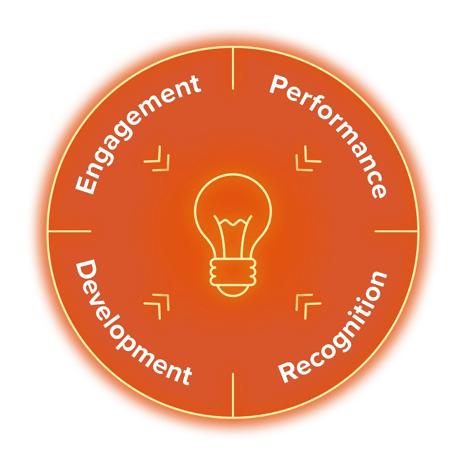
Most of the platforms above do one or two things well and treat the rest as an add-on. Quantum Workplace was built around a different idea: connect engagement, performance, development, and recognition into one system, so leaders see the full picture instead of four separate snapshots.
- Engagement. Run engagement, lifecycle, and pulse surveys built on a scientifically validated model, then turn results into action with AI-generated focus areas and discussion starters. Retention Radar layers in real-time flight-risk predictions, so you can see which teams are at risk before someone hands in their notice. Benchmarks against a database of more than 10,000 organizations add context to every score.
- Performance. Align teams around goals and OKRs, run better 1-on-1s, and gather 360-degree feedback continuously. Ask AI suggests what to include in reviews to reduce recency bias, and automated review cycles cut the administrative load on HR. Managers get a performance snapshot pulling goals, feedback, and review data into one view.
- Development. Give employees AI-powered career visions, competency mapping, and transparent career paths, so growth feels like a real plan and not an annual afterthought. Talent Reviews use 9-box or 4-quadrant visualization to spot rising stars and flight risks, and that data feeds directly into Succession Planning, with readiness tracked in 12-month increments.
- Recognition. Make appreciation visible with peer-to-peer recognition, AI-assisted writing help, and custom awards and milestones tied to your company values. Rewards support more than 100 countries and thousands of gift card options, and Slack and Microsoft Teams integrations put recognition where work already happens.
What makes this connected instead of just comprehensive is what a manager actually sees. Pull up any employee's record and you get their 1-on-1 history, peer and upward feedback, goal progress, development plan, recognition and milestones, past performance reviews, survey sentiment, and 9-box talent review rating in one place.
Quantum Workplace's Insights Hub takes that connection a step further, using AI to surface people insights and recommendations that help leaders make more informed decisions. That matters most when the answer isn't obvious. Overall attrition and survey-based intent to stay can look similar across every manager's team. It's only when you overlay talent review data, isolating your top performers specifically, that a real gap shows up: one manager's high performers leaving at a meaningfully higher rate than everyone else's. Insights Hub surfaces that pattern automatically, points to where the signal came from, and suggests next steps, turning a blind spot into something a leader can act on immediately.
Looking for more comparison guides?
- Choosing the Best Employee Engagement Software
- Top Employee Engagement Survey Vendors
- Selecting the Best Performance Management System
- Top Career Development Tools
Frequently asked questions
What's the difference between talent management and performance management?
Performance management is one piece of talent management, focused on goals, feedback, and reviews. Talent management is the broader category, covering engagement, performance, development, and recognition together.
How long does it typically take to implement a talent management system?
Timelines vary widely by platform and organization size. Point solutions like Lattice or 15Five can launch in weeks, while enterprise suites like Workday or SAP SuccessFactors often take several months for a full global rollout.
Do small businesses need a talent management system?
Even smaller teams benefit from structured goal tracking and feedback once headcount reaches roughly fifty to one hundred employees, when informal, in-person management starts to lose consistency.
Can a talent management system replace our HRIS?
Not usually. Most organizations run a talent management system alongside their HRIS, since the two solve different problems: one manages records and pay, the other manages growth and engagement.
What should we prioritize if we can only implement one module first?
Start wherever the pain is sharpest. If turnover is the pressing issue, begin with engagement and recognition. If manager inconsistency is the concern, start with performance and goals.
How is Quantum Workplace different from a standalone performance or engagement tool?
Quantum Workplace connects engagement, performance, development, and recognition into one system, so leaders act on a full picture of their people instead of four disconnected data sources.
Note: The information presented on this page is sourced from third-party review sites, vendor websites, and user reviews. While we strive to ensure accuracy, product features, integrations, and capabilities may change over time. We encourage readers to verify details directly with the respective vendors before making a purchase decision. If you notice any discrepancies or outdated information, please contact us at marketing@quantumworkplace.com so we can update our content accordingly.