



From People Analytics to People Insights: Why the Shift Matters for People Leaders
People analytics tells you what is happening in your workforce data. People insights tell you what it means and what action to take next.
That difference matters because most HR teams already have plenty of data. What they need is clarity, and they need it fast.
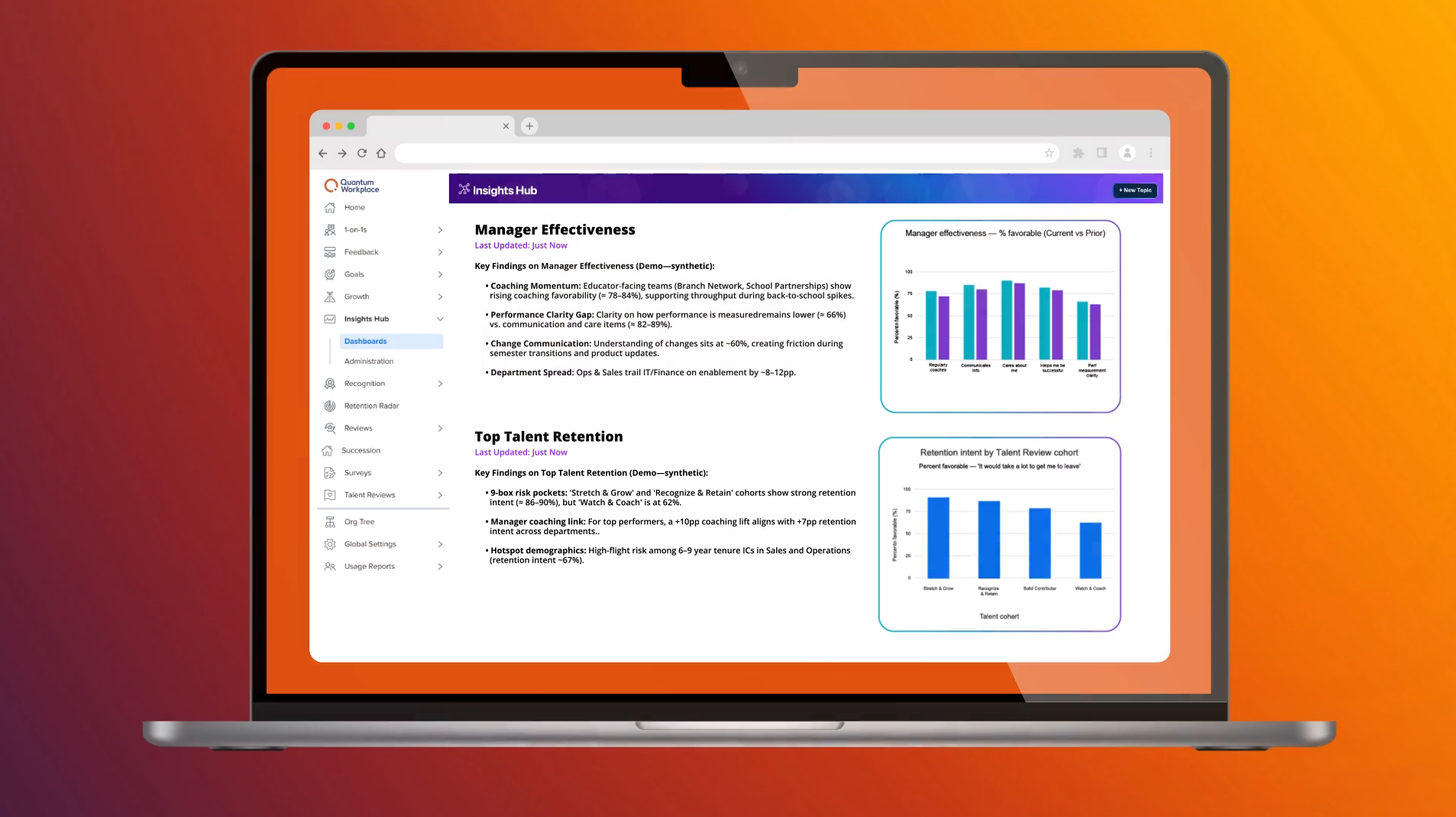
Insights Hub acts as a virtual analyst and coach, surfacing insights shaped around your organization’s point of view on topics like manager effectiveness. They are so relevant that your leaders can’t help but act.
It connects your engagement, performance, development and recognition data [Coming soon]. Then it turns that data into findings your leaders can act on.
Definition block
People analytics: The practice of collecting and analyzing workforce data to describe what is happening, such as turnover or engagement trends.
People insights: Interpreted findings that connect signals across your data, explain why they matter, and recommend the right next step.
Quantum Workplace Insights Hub: An AI-powered people insights tool that works like a virtual HR analyst and leadership coach.
You have your people data. You still don't have the answers.
If this sounds familiar, you are not alone. You pull a turnover report on Monday. You open an engagement dashboard on Tuesday. By Friday, you are building a slide deck to explain what the numbers might mean.
That work is real, and it takes time you do not have. Meanwhile, the leaders who need answers are waiting.
Forrester notes that many organizations stay stuck in a cycle of data collection followed by limited action. The data is not the problem. The time between collecting the data, analyzing it, and making the right decision is.
Where traditional people analytics stops
Traditional people analytics is valuable. It gives you trends, benchmarks, and a shared view of the numbers.
But it usually stops at a description. People managers and leaders still have to interpret the chart, connect it to other reports, and decide what to do.
People insights pick up where analytics leaves off. The table below shows the difference at a glance.
|
|
People analytics |
People insights |
|
Core question |
What happened? |
Why did it happen, and what should we do? |
|
Typical output |
Dashboards and reports |
Explained findings with recommended actions |
|
Who interprets |
An analyst or HR partner |
The system explains it in plain language |
|
Data view |
One metric or report at a time |
Signals connected across engagement, performance, development and recognition [COMING SOON]. |
|
Relevance to your organization |
Standard metrics and views |
Findings shaped around your organization’s point of view, such as how you define manager effectiveness |
|
When data is missing |
A blank spot in the report |
A clear note on what is missing and how to fill the gap |
|
Next step |
Left to the reader |
Suggested actions that can be tracked |
|
Best for |
Measuring and monitoring |
Deciding and acting |
Insights Hub makes the shift to people insights real
Insights Hub works the way a good analyst would. It starts with your priorities and builds from there.
1. It starts with topics that matter to youYou choose a topic, such as Manager Effectiveness or Top Talent Retention. You can also create a custom topic for any strategic priority.
A topic is a framed area of analysis. It tells Insights Hub what questions matter for your organization.
2. It learns your point of viewCue, our AI agent, guides setup through a short conversation. It starts with Quantum Workplace's research-backed view of the topic.
Then you add your own perspective. Setting up a topic takes about five to ten minutes.
3. It looks across your dataOnce a topic is set, Cue investigates patterns across your Quantum Workplace and HRIS data.
The more connected your data is, the stronger the insights become.
4. It explains what it findsEach insight shows what we are seeing, why it matters, and how to read the chart. Findings are supported by cited sources.
You can ask Cue follow-up questions about any insight. Those conversations stay private to you.
5. It tells you what it cannot seeWhen the data is not enough, Cue says so. It does not guess.
Instead, it shows a data gap and suggests how to close it. For example, it might point out that exit survey feedback is incomplete.
Those gaps become a map of where to invest next.
6. It points to the next actionCue recommends actions tied to each topic. You can add an action, track its progress, and mark it complete.
An insight is only useful if someone does something with it. That is why the action step is built in.
6 ways people insights benefits people leaders
People insights give leaders clearer answers in less time. Here are six ways that shows up in your daily work.
1. You get to the answer faster
Building a talent report by hand can take days. Insights Hub changes that by doing the research for you.
Cue plans a set of questions, investigates your data, and surfaces the findings worth your attention. You spend your time deciding, not surfacing information in spreadsheets.
2. You see the full picture, not one metric at a time
A single number can send you in the wrong direction. Two managers can have the same turnover and very different stories.
Insights Hub connects engagement, performance, development, and recognition signals [COMING SOON]. That context helps you tell who is leaving, and why it may be happening.
3. HR becomes a more strategic partner
Many HR teams spend their week pulling data for other people. That leaves little room for advising the business.
With analysis handled, your team can walk leaders through what matters. You show up to meetings with a point of view, not another spreadsheet.
4. Managers get guidance they can use
Managers are busy, and few have time to read a dashboard. Insights are written in coaching-style language that explains what is happening and why it matters.
The tone builds ownership. Insights are written for leaders, not about them, so managers feel supported rather than judged.
5. Every insight points to a next step
An insight with no action is easy to ignore. That is why Insights Hub recommends actions tied to each topic.
You can add an action, track its progress, and mark it complete. Over time, you can see what you committed to and what you finished.
6. You know where your data has gaps
Every organization has blind spots. Insights Hub shows them instead of guessing.
If exit survey feedback is incomplete, for example, Cue says so and suggests how to fix it. Those gaps help you decide where to invest next.
This ties back to the four pillars of a healthy workplace: engagement, performance, development, and recognition. People insights show how those signals influence each other, so you can act on the whole picture not partial ones.
Checklist: Are you ready for people insights?
- You collect engagement, performance, development and recognition data, but struggle to connect it.
- Leaders ask "so what?" after reviewing dashboards.
- Your team spends hours each cycle building reports by hand.
- You want managers to act on data without needing an analyst to translate it.
- You have one or two strategic topics, such as manager effectiveness or top talent retention, that need ongoing attention.
- You want to know where your data has gaps before they become blind spots.
If you checked two or more, people insights are likely a good next step.
Make the shift from data to decisions
You already do the hard work of collecting people data. Insights Hub helps you turn it into clear, confident action. Explore how Insights Hub can work for your organization.
Frequently asked questions
What is the difference between people analytics and people insights?
People analytics describes what is happening in your workforce data. People insights interpret that data, explain why it matters, and recommend what to do next.
What is Quantum Workplace Insights Hub?
Insights Hub is an AI-powered people insights tool. It works as a virtual analyst and coach, connecting your people data into explained findings and suggested actions.
What data does Insights Hub use?
It draws on your Quantum Workplace data, including engagement, performance, and development. It can also use HRIS data. Insights get stronger as you connect more of your data. Recognition data is coming soon, as Insights Hub is in beta and we keep adding more data connections.
What happens if my data is incomplete?
Insights Hub works with the data you have today. When something is missing, it shows a data gap and explains how to close it.
Do I need to be an analyst to use it?
No. You describe what matters to your leadership team, and Cue prioritizes insights around it. Setting up a topic takes about five to ten minutes.