

The Cost of Unnoticed 👉  see why recognized employees are 7.2X more likely to stay.  — Download the report

Get the latest workplace insights sent straight to your inbox.

Get the latest workplace insights sent straight to your inbox.

Skip to main content

2026 Gartner® VoE Report 👉 See what they say about the future of employee listening — Download the free report

Get the latest workplace insights sent straight to your inbox.

Get the latest workplace insights sent straight to your inbox.

four colleagues discussing how to evaluate hr technology

Before the Business Case:
3 Principles for Evaluating HR Technology

Your case will be stronger when it's built on more than today's pain. Read this article for tips on framing your ask around business outcomes, better people decisions, and your company's trajectory.

This is Part 1 of a five-part series on building the business case for a connected talent platform. If you'd like to be the first to know when a new section is released, subscribe to the series below.

The hardest part of investing in new HR technology usually isn’t finding the right solution. It’s helping the rest of the business see how the current way of working is limiting the organization—and why change is worth prioritizing.

HR sees the consequences of disconnected talent data every day. Talent insights are scattered across systems, and leaders are making consequential people decisions from partial pictures. HR is spending too much time pulling information together instead of helping leaders understand it and act.

As a result, there are business-critical questions leaders can’t answer confidently:

  • Where are our strongest performers at risk?
  • Which managers and teams need more support?
  • Are we developing the talent our future strategy requires?
  • Where are we investing in people without seeing the intended impact?

That uncertainty has a measurable cost. According to Korn Ferry research, 99% of leaders say disconnected talent data has a negative financial impact on their organization—and more than 80% estimate the cost at 3% or more of total payroll.

99%

of leaders say disconnected talent data is having a negative financial impact on their business

80%

of leaders estimate disconnected talent data is costing them at least 3% of payroll

Still, seeing the problem and securing the investment to solve it are two different challenges. According to Gartner, building a credible internal business case is the single biggest barrier to HR tech investment.


You can rigorously compare every HR tech vendor in a category, find the right fit for your organization, and spend weeks or months building a thoughtful recommendation. But when that recommendation moves up the chain, it’s easy for the “why” to get lost.

The questions start rolling in:

  • What problem are we solving?
  • Why now?
  • Didn’t we buy something for this two years ago?
  • Aren’t there cheaper options?
  • Can’t we do this with something we already own?
  • Is the value worth the investment?

Answering those questions takes more than a well-researched recommendation. It requires clarity about the business outcome you’re trying to create, how connected talent insights will help leaders make better decisions, and what the organization you’re becoming will need from its people and technology.

Those principles give you the foundation for everything that follows—from defining the problem and aligning stakeholders to demonstrating value. So before we get into the evidence into the evidence, ROI, and presentation deck, let’s start there.

Subscribe to the business case series

This is a five-part series with weekly releases. Be the first to know when each new section of the series is live.

Principle #1: Thriving teams are a business outcome.

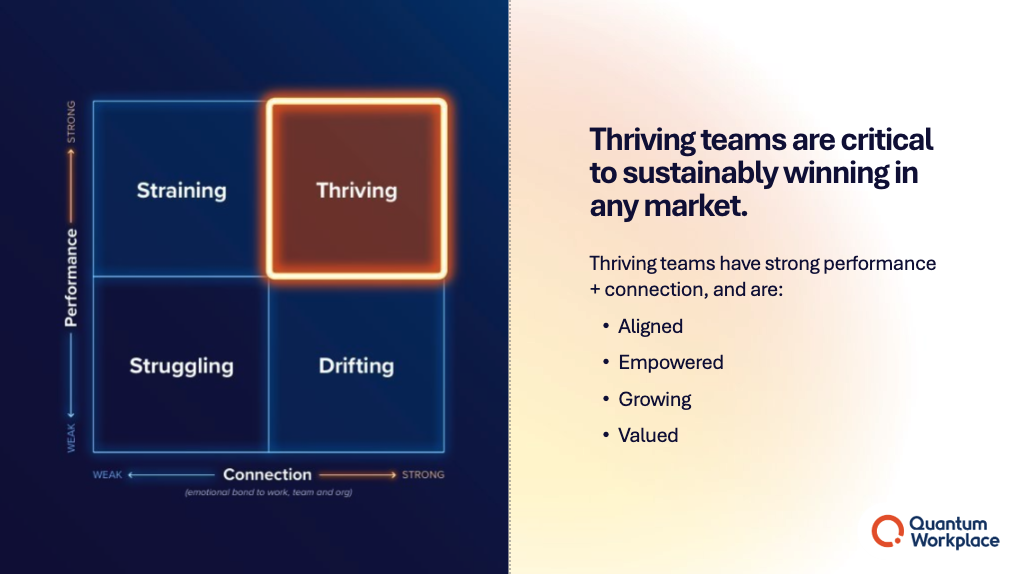
Thriving teams have a strong connection to their work, team, and organization—and they perform at a high level. Businesses need both. Engagement without performance won’t deliver results. Performance without engagement rarely lasts.

Whether your teams are thriving (or not) influences:

  • How long your best people stay
  • How quickly your new hires ramp
  • The effectiveness of your managers
  • Whether the business strategy gets executed

Thriving teams need purpose-built technology.

Your talent technology needs to do more than simply run a process. While payroll needs to be accurate and benefits administration needs to be reliable and straightforward—thriving teams need strategic insights and tools that help move them forward.

Employee listening and performance tools that are bundled into your HRIS may check a functional box. But they don’t give leaders the insight, guidance, or tools to build a thriving team. These tools are convenient—but convenience shouldn’t be the gold standard when it comes to supporting one of your organization’s largest investments: your talent.

“It’s very hard for these big platforms to be everything to everybody. We saw very limited configuration or customization. Now we’ve got platforms specializing in talent who are focused on integration in order to provide best-in-class products.”

Director of Talent Management at an Enterprise Food Distribution

The same test applies to generic AI tools, which can save real time by bringing information together, finding initial themes, and translating complex data. They’re especially useful for exploratory questions, when a fast, directional answer is enough.

But an exploratory tool is not necessarily a trustworthy decision-making tool. When AI informs decisions about performance, promotions, development, or retention, you need to know what data shaped the answer and whether the interpretation can be trusted. Without that context, the time savings can become a correction tax: HR still has to catch faulty assumptions, remove irrelevant information, and reshape the answer around the organization’s reality.

“AI has sped up a lot for us, but I still spend a lot of time molding the review to the reality of our data. Time savings and trust in the insights are two key factors for me.”

Marie Potter, Vice President, Talent and Culture at Getty Images

AI within a purpose-built, connected talent platform can work from established definitions, permissions, and the most relevant organizational context.

As you evaluate technology options and build your case, be sure to focus on what will change for the business—not just what the platform will do.

“Better engagement reporting” is a feature benefit. Reducing regrettable turnover, helping new hires contribute sooner, building a stronger leadership bench, and helping managers lead more effectively are outcomes leaders already care about.

Then, make those outcomes concrete:

  • What is happening today?
  • What does continuing as-is cost?
  • What should look different once the plan is in place?

Principle #2: Better connection in, better decisions out.
Screenshot 2026-09-09 at 12.33.48 PM


For teams to thrive, four conditions must be true:

  • People are aligned on what matters.
  • They feel empowered to speak up and act.
  • They’re growing in ways that support the business.
  • They feel valued for what they contribute.

In most organizations, the signals you need to understand if teams are thriving all live in different places—scattered across systems, data sets, and what’s in each leader’s head. A report from Korn Ferry states:

  • 84% of leaders say they operate in 3-10 different platforms
  • 34% of leaders are confident the insights from their talent data are reliable
  • 26% say it can take weeks to access connected talent insights

84%

of leaders say they operate in 3-10 different platforms

34%

of leaders are confident the insights from their talent data are reliable

26%

say it can take weeks to access connected talent insights

That fragmentation comes at a cost. The same report says 99% of leaders say disconnected data is having a negative financial impact on their business—with 80% of those leaders estimating it’s costing them at least 3% of total payroll.

Leaders lack context.

An engagement score of 74 might look like something that needs to be addressed promptly. But without understanding what’s behind it or how it compares, it can send a leader confidently in the wrong direction, making plans that don’t address the real problem.

Bias goes unchecked.

When one manager rates performance realistically and another rates everyone as exceptional, it skews promotion, development, and succession decisions—reflecting the rater's views more than anything else.

Decisions come too late.

When you’re manually pulling the data from each system and piecing the story together by hand, it takes a lot of time. By the time you share the insight, the organization or team may have already changed, and the window to act may have closed.

None of these costs appear as a neat line item on the P&L, but they’re all expensive. And the opportunity is significant. According to Korn Ferry, when data does connect, leaders report:

  • increased productivity

  • faster time to hire

  • stronger engagement

  • reduced costs

  • reduced turnover

A strong business case is less about what the technology does and more about what leaders will be able to see, decide, and do differently because of it. Use three questions to test any platform—and the case you’re building for it:

  • Does it connect the talent data you already collect?
  • Does it uncover patterns leaders may not think to investigate?
  • Does it help leaders act while there is still time to make a difference?

"We're always looking for better ways to connect and interpret our talent data, including how we understand the connections between turnover, performance, and engagement. We're working to build a more cohesive view that tells a clearer, more consistent story and enables better decision-making across HR and the business."

Marie Potter, Vice President, Talent and Culture at Getty Images

Principle #3: Buy for the organization you're becoming.

Most business cases are built around today’s pain. That’s understandable. It’s also why so many investments get questioned again eighteen months later.

As you evaluate vendors and build your case, look beyond the immediate problem:

  • Where is the business headed?
  • What will your talent strategy need to support that direction?
  • What will you need to do 1, 3, and 5 years from now that you can’t do today?

Maybe it’s helping every manager connect their team to a new business strategy rolling out in the coming months. Maybe it’s improving customer experience through stronger engagement and performance. Or maybe it’s prioritizing targeted development at every level to make sure the business is ready for the future.

These are capabilities you need to actively and intentionally build, not features you need to buy.

Also think about how your HR team needs to scale. Business growth rarely comes with a proportional increase in HR headcount. You need technology that’s going to help reduce manual work, maintain or improve service levels, and make sure the strategic work doesn’t get crowded out. How can a more connected and modern talent platform help your team’s capacity keep pace with the business?

"We're a high-growth company, and one of the biggest things is being able to think about the scalability of every single thing that we do. Not: how is this going to work for us today, and what problem will it solve that we have now? But: how is it going to grow with us three, five, seven years down the road, when we're a completely different company?" 

Caitlin Austin, Director of Talent Performance and Development at WSB

Let's get to work!

Your business case is more than the deck you assemble at the end of this process. Do it well, and you’ll create shared clarity about the problem, the costs of continuing as-is, the options available, the outcomes that matter, and how you’ll know the investment is working.

The rest of this series will help you build a business case that makes the right decision much easier to see, grasp, and say yes to.

Let's move on to Part 2, where we turn these principles into proof.


About the Series

This is a five-part series designed to help HR leaders build the business case for a connected talent platform. Each part covers a key step in the process, offering guidance and interactive resources to help you think through your own process and make a solid case.

See the value of our connected talent platform.

Take a self-guided tour to see how you can give your leaders the context, clarity, and confidence to make better talent decisions.