



.webp?width=500&height=281&name=Employee%20Engagement%20Trends%202026%20(4).webp)

As a leader, one of your top priorities is to help your team members succeed and feel engaged with their work. But if you don't create psychological safety at work, those ambitions will not be possible.
In fact, data from Gallup reveals that just three in 10 U.S. workers strongly agree that their opinions seem to count at work. Further, one study revealed that by moving that ratio to six in 10 employees, organizations would realize a 27% reduction in turnover.
This guide is designed for HR and People leaders, employee experience and culture teams, organizational development leaders, managers, and team leads who want employees to speak up, share feedback, learn from mistakes, and contribute ideas without fear of negative consequences.
In this article, we'll talk about what psychological safety is, why it matters, and strategies for creating it at work.
-
What is psychological safety
-
What does psychological safety matter
-
How to measure psychological safety
-
How to create psychological safety at work
What is psychological safety?
Dr. Amy Edmondson, the Harvard Business School professor who coined the term psychological safety, defines it as, "a belief that one will not be punished or humiliated for speaking up with ideas, questions, concerns or mistakes."
Edmondson pointed to psychological safety as a critical factor for high-performing teams. More recently, Google's research on characteristics of high-performing teams identified psychological safety as their top indicator of the performance of a team.
Teams with strong psychological safety are less afraid of the negative consequences that may result from:
- Taking smart risks
- Making mistakes
- Sharing their opinions within their team
- Being candid with one another
Because of this, these teams are more likely to share their opinions when they differ from one another (e.g., avoid group think) and take initiative when it matters most.
What psychological safety is — and what it is not
|
Psychological safety is… |
Psychological safety is not… |
|
Being able to ask questions, challenge assumptions, admit mistakes, and raise concerns. |
Avoiding difficult conversations or protecting people from all discomfort. |
|
A climate where respectful candor and interpersonal risk-taking are expected. |
A guarantee that every idea will be accepted or implemented. |
|
Compatible with high standards and accountability. |
Lowering performance expectations or excusing poor behavior. |
|
A team-level condition created through repeated leader and peer behaviors. |
A one-time training, slogan, or HR initiative. |
|
A foundation for learning, inclusion, feedback, and innovation. |
The same thing as simple friendliness, agreement, or conflict avoidance. |
Why does psychological safety matter?
Teams that feel empowered to share their perspectives with each other, especially when their opinions differ from the rest of the group, are able to more fully leverage the knowledge and talent that each member brings to the team. These teams are more likely to take initiative and consider the full picture of each situation. This in turn enables the team to innovate and find effective solutions.
Psychological safety is also critical to a team's ability to give and receive candid, respectful feedback. If your organization is looking to build a stronger feedback culture, take a look at employee perceptions of psychological safety as a starting point.
Benefits of psychological safety
When it comes to performance, creating a trusting environment is essential. The Harvard Business Review has shared multiple studies that describe psychological safety as an important factor in high-performing (and hybrid) teams, and the teams who are most effective at problem solving have been shown to share two common traits: cognitive diversity and psychological safety.
Not only does psychological safety improve your team’s performance, it also enhances employee engagement. When team members feel that their insights are appreciated they:
- Feel like a respected part of their team
- See the value of their work
- Feel accepted for who they are and the unique strengths they bring
The relationship between psychological safety and DE&I
Psychological safety is a key component of diversity, equity, and inclusion efforts. Diverse opinions, experiences, and knowledge can be better leveraged if team members feel comfortable speaking up and are accustomed to considering alternate viewpoints. Highly inclusive teams are empowered to share their unique perspectives with each other and are better positioned to reap the benefits of having a diverse team.

How to measure psychological safety
One way to measure psychological safety in your organization is through employee surveys. However, traditional psychological safety assessments tend to focus solely on perceptions at the team level. Consider asking questions that measure employees' perceptions of psychological safety both at work and within their team.
Leverage a pulse survey template to ask the right questions about whether team members feel that they can share their opinions, take risks, and make mistakes.
When reviewing your results, focus your data analysis at the team-level, rather than within the organization overall. While it's valuable to have an understanding of the level psychological safety throughout your organization, any action that you take to improve psychological safety will be most effective within teams.
Survey questions
Measure psychological safety at the team level with questions that assess speaking up, mistakes, risk-taking, manager response, and inclusion. Use a consistent response scale so teams can compare results over time
· I can raise concerns on my team without fear of negative consequences.
· My manager responds constructively when employees make honest mistakes.
· People on my team can disagree with one another respectfully.
· I feel comfortable asking for help when I need it.
· My ideas and opinions are taken seriously by my team.
· I can challenge the way we do things when I see a better approach.
· People on my team are treated fairly when they speak up.
· My team learns from mistakes rather than hiding or assigning blame.
Recommended response scale: Strongly disagree / Disagree / Neither agree nor disagree / Agree / Strongly agree.
Low vs. high psychological safety: workplace examples
|
Workplace situation |
Low psychological safety |
High psychological safety |
|
A mistake occurs |
Employees hide it or wait for someone else to notice. |
The employee surfaces it early, explains what happened, and helps prevent recurrence. |
|
A leader proposes a plan |
Team members stay silent even when they see risks. |
Team members respectfully challenge assumptions and share contrary evidence. |
|
A meeting is dominated by a few voices |
Quieter employees disengage or follow the group. |
The manager explicitly invites missing perspectives and gives people time or alternate channels to respond. |
|
Priorities change |
Employees speculate privately and avoid asking questions. |
Leaders explain what changed and why, and employees can surface concerns or tradeoffs. |
|
Feedback is needed |
People soften, delay, or avoid feedback. |
Peers and managers exchange candid, specific, respectful feedback focused on improvement. |
9 strategies to create psychological safety at work
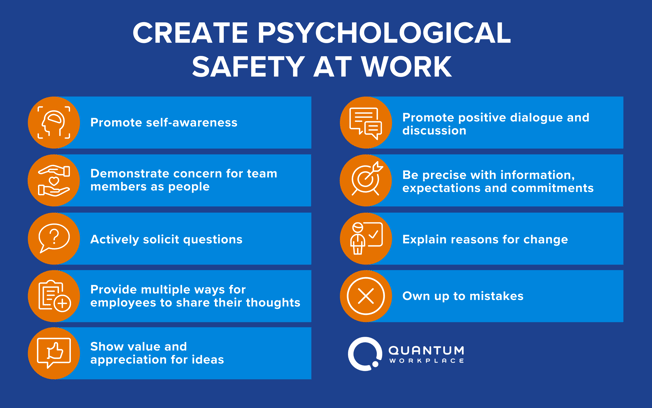
Now that you know what it is, why it matters, and how to measure it—how do you transform your team environment and create psychological safety at work? Try using these nine strategies to create psychological safety at work.
- Promote self-awareness – Encourage employees and leaders to understand their own communication styles, biases, and impact on others so they can engage more thoughtfully with the team.
- Demonstrate concern for team members as people – Show genuine interest in employees' lives beyond their job duties. Simple check-ins and empathy build trust.
- Actively solicit questions – Create regular opportunities (meetings, forums, Q&As) where employees feel invited — not just allowed — to ask questions.
- Provide multiple ways for employees to share their thoughts – Not everyone is comfortable speaking up in a group. Offer surveys, suggestion boxes, one-on-ones, or anonymous channels.
- Show value and appreciation for ideas – Recognize contributions publicly and follow through when possible, so people see that speaking up leads to something.
- Promote positive dialogue and discussion – Foster a culture where healthy debate and differing opinions are welcomed rather than shut down.
- Be precise with information, expectations and commitments – Vague direction breeds anxiety. Clear, consistent communication builds confidence and trust.
- Explain reasons for change – When change happens, tell people the "why," not just the "what." This reduces fear and resistance.
- Own up to mistakes – Leaders modeling accountability — admitting errors openly — gives employees permission to do the same without fear of punishment.
1. Promote self-awareness.
To create psychological safety in the workplace, start by building self-awareness in your team. When you recognize how you prefer to think and behave, you can uncover biases that might be impacting your employees’ willingness to share their viewpoints.
Self-awareness also empowers you to understand your typical responses to changes or challenges. With this knowledge, you can adjust your emotional responses and learn to react in a way that invites open discussion.
There are multiple ways to begin building self-awareness, including using 360° reviews and assessments like the Emergenetics Profile to better understand yourself and your team.
2. Demonstrate concern for team members as people.
You may or may not be naturally inclined to ask team members how they are doing. Still, by getting into the practice of checking in with your employees, you demonstrate your concern and interest in them as people. Taking this simple action can help team members feel more comfortable speaking up because they know you appreciate their whole selves – not just their work product.
3. Actively solicit questions.
As your team is arriving at a decision, pause your meeting to ask for questions, different viewpoints and considerations that have not yet been voiced. And, count to ten in your mind before moving on. Often, internal processors may need more time to formulate their thoughts before voicing them, so train yourself to pause and encourage input.
4. Provide multiple ways for employees to share their thoughts.
While some employees may be comfortable sharing their thoughts in a meeting, others may prefer to have more time to think through their responses. Encourage team members to share feedback via email or through online collaboration tools, like Slack or Microsoft Teams, in addition to in-person discussions.
5. Show value and appreciation for ideas.
If you truly want your employees to openly share their thoughts, you must establish an environment where they feel all ideas are welcome. As you brainstorm, suspend judgement. Remember, you do not need to act on every idea; however, thanking people for their contributions and showing appreciation for their insights will go a long way in establishing psychological safety.
6. Promote positive dialogue and discussion.
Encourage team members to use positive language to inspire honest conversations. Cognitive studies have shown that affirmative language can actually motivate you to succeed. Simple word changes like using “have not yet” in place of “can’t” or “opportunity” instead of “challenge” can help your team members employ a positive mindset that empowers them to speak up without fear.
7. Be precise with information, expectations and commitments.
To build psychological safety, your team members need to trust you and your word, so be mindful about the information you share as well as the expectations and commitments you set. Be accurate. Be realistic. And, be thoughtful. Setting clear expectations and adhering to your commitments will help employees trust you and be more open with you.
8. Explain reasons for change.
In the course of business, timelines will shift and your plans will need to adjust. Some of your team members will have an easy time transitioning while others may be thrown. When expectations change or new information is revealed, be clear about what changed and why and give your team members time to process the change.
9. Own up to mistakes.
Failure can be frightening, and as a leader, you can take the sting out of it for your employees by owning up to the mistakes you’ve made and celebrating failures as learnings. Regularly ask employees what they’ve done that didn’t work out as expected and what they learned from those experiences. Doing so will help team members recognize that they won’t be punished for mistakes and help them feel more comfortable taking risks and speaking up.
As a leader, the tone you set for your team has the power to make or break your employees’ success and engagement. When you employ these nine strategies to build psychological safety, you will empower your employees to share their ideas, learnings and concerns, which will spark your team’s performance.
7 common barriers to psychological safety
-
Punitive or defensive reactions when employees raise problems.
-
Leaders who dominate discussion or signal that disagreement is unwelcome.
-
Unclear expectations about which risks, experiments, or decisions employees can make.
-
Repeated requests for feedback without visible follow-through.
-
Favoritism, exclusion, or inconsistent consequences across employees.
-
High power distance, where junior employees believe speaking up may damage their reputation or career.
-
Meeting norms that reward speed and consensus over questions and dissent.
FAQs
What does psychological safety look like at work?
In a psychologically safe workplace, employees ask questions, admit mistakes, challenge assumptions, request help, and share concerns. Leaders respond constructively, invite different viewpoints, and maintain clear performance expectations.
What is an example of psychological safety in the workplace?
A simple example is an employee telling a manager that a project plan has a serious risk. Instead of becoming defensive or punishing the employee, the manager asks questions, evaluates the concern, thanks the employee for speaking up, and explains the decision that follows.
How can managers create psychological safety?
Managers can create psychological safety by inviting questions, listening without defensiveness, responding constructively to mistakes, explaining changes, asking for different viewpoints, following through on feedback, and modeling candor by admitting what they do not know.
Is psychological safety the same as trust?
They are related but not identical. Trust often describes how one person views another person, while psychological safety describes a shared team climate in which people believe interpersonal risks such as speaking up are safe.
Does psychological safety reduce accountability?
No. Psychological safety is compatible with high standards and accountability. It makes it safer to surface problems, ask for help, learn from mistakes, and challenge weak assumptions so teams can improve performance.
Relationships are critical to the success, engagement, and psychological safety of individuals and teams at work. Download our ebook, The Relationship-Driven Workplace, to learn how you can build (and measure) better relationships in your workplace.