




.webp?width=500&height=281&name=Employee%20Engagement%20Trends%202026%20(4).webp)

Think about the last time you put your heart and soul into a project or presentation, molded it into something you were proud of, and absolutely nailed the execution. That feeling of accomplishment is uplifting—but it is multiplied exponentially when others take notice.
The simple act of acknowledging achievement is a major boost for employee morale and performance. And that’s why employee recognition is so critical.
When you reward employees for their contributions, they feel ownership and pride—and are willing to work just as hard on their next project. Recognition connects them to the organization, elevates performance, and increases the likelihood they’ll stay.
This article provides research-backed advice on how to give the kind of employee recognition that will truly make a difference in employee engagement, performance, and retention.
What is employee recognition?
Employee recognition is the open acknowledgment and praise of employee behavior or achievement. It’s used by organizations to express appreciation, motivate employees, and reinforce desired behavior.
If you regularly give out authentic, deserved recognition to employees, you’ll be that much closer to unlocking their full potential. Authentic recognition serves three key purposes:
1. Showcase goal achievement
A simple “thank you” is often all it takes to show appreciation to employees. People want to know that their hard work and achievements aren't going unnoticed. When a person achieves a goal—personal or work-related—they feel a rush of achievement, and that good feeling is only amplified when others recognize and acknowledge the achievement as well.
2. Motivate effort
Recognition can be tied to more than just performance. Celebrate strong effort when employees go above and beyond. This helps them develop emotional connections to the workplace that fuel future performance.
3. Reinforce values
Behaviors and actions that are recognized more frequently show employees what’s valued by managers, leaders, and the organization as a whole. When employees receive recognition for adopting a behavior aligned with company values, they’re likely to continue that behavior and set a positive example for others.
What is the importance of employee recognition?
Recognition is a powerful feedback tool. When employees feel valued, they’re more engaged, motivated, and likely to go the extra mile for their company. Organizations with formal employee recognition programs have 31% less voluntary turnover than organizations that don't have any program at all. And they're 12x more likely to have strong business outcomes.
If leaders want to drive employee, team, and business success, they need to prioritize employee recognition.
The connection between employee recognition and engagement
Aspects such as performance, goals, recognition, development, and manager effectiveness are all inextricably linked to employee engagement. And recognition is one of the top drivers of employee engagement.
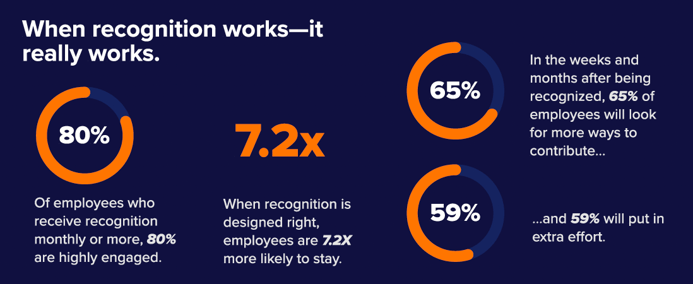
In fact, our research found that when employees believe they will be recognized, they are 7.2x more likely to stay at their organization. 80% are highly engaged when they are recognized monthly or more and the payoff of this is that 65% will look for more ways to contribute and 59% will go the extra mile.
Other items related to recognition that drive employee engagement, include:
- The senior leaders of this organization value people as their most important resource.
- If I contribute to the organization’s success, I know I will be recognized.
- I understand how my job helps the organization achieve success.
Benefits of employee recognition
Employee appreciation is a fundamental human need. When employees feel appreciated and recognized for their individual contributions, they will be more connected to their work, their team, and your organization as a whole.
Here are a few other benefits of employee recognition:
- Increased productivity and engagement
- Decreased employee turnover
- Greater employee satisfaction and enjoyment of work
- Improved team culture
- Higher loyalty and satisfaction scores from customers
- Increased retention of quality employees
- Decreased stress and absenteeism
Research shows a gap in employee recognition
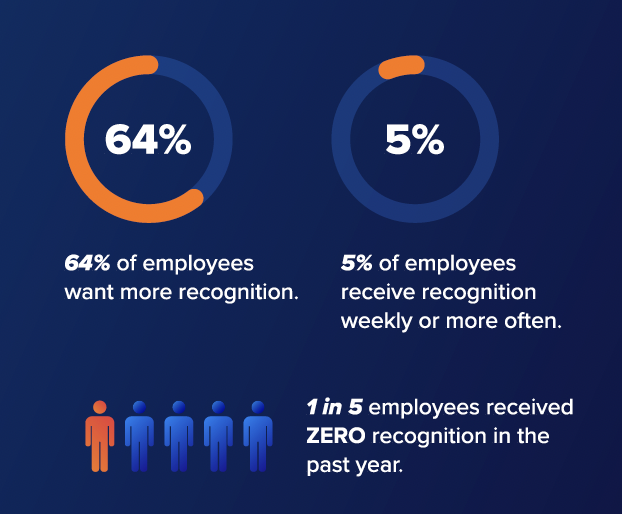
Quantum Workplace research shows a gap between what employees want and what they're actually getting when it comes to employee recognition. Only 5% of employees receive recognition weekly or more. And 64% of employees would like more recognition for their work.
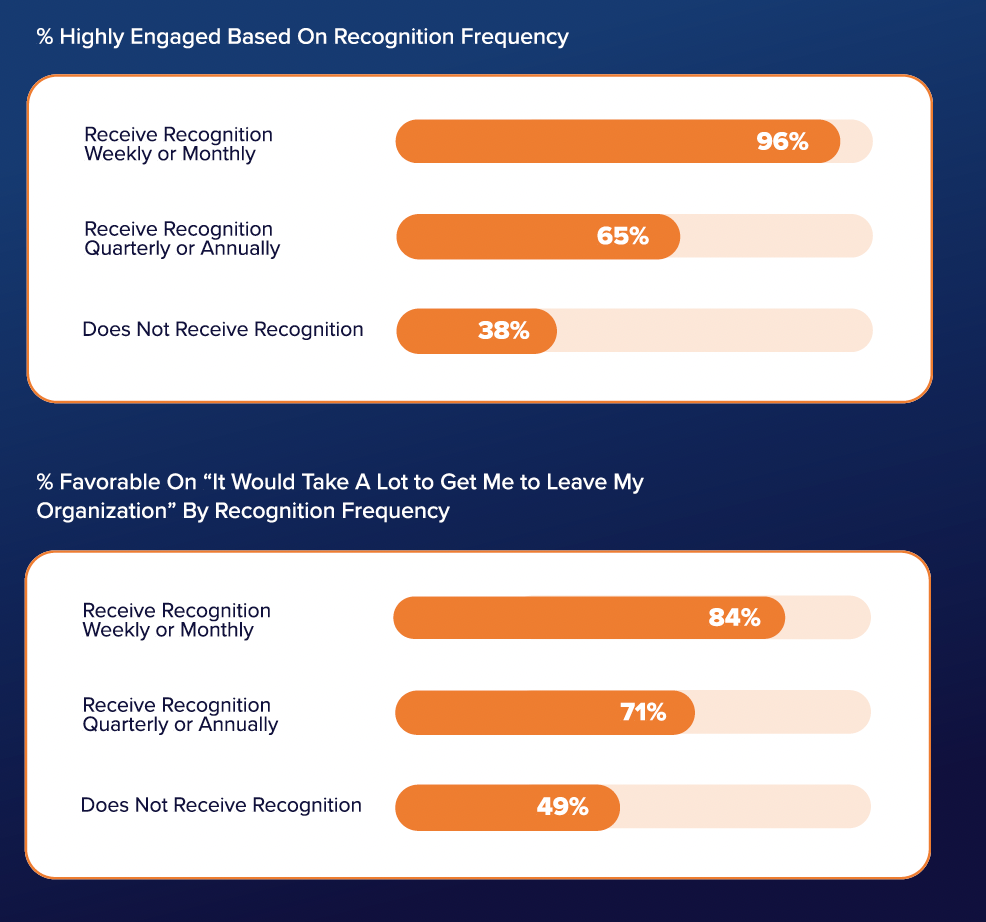
Frequency of recognition is linked to stronger engagement and retention
Employees who receive less frequent recognition want more—especially those who get it less than monthly. All employees crave more recognition, even managers! Everyone wants to be recognized for their contributions and feel like a valuable member of the team and organization.
Our research has found that organizations have more work to do here. The barriers keeping recognition from happening are when HR have to fight its way through approvals, reminders, and extra steps to just give employees the recognition they deserve.
Types of employee recognition
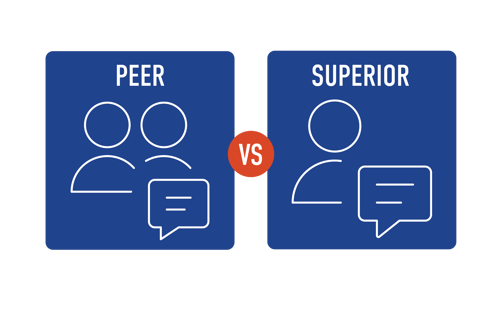
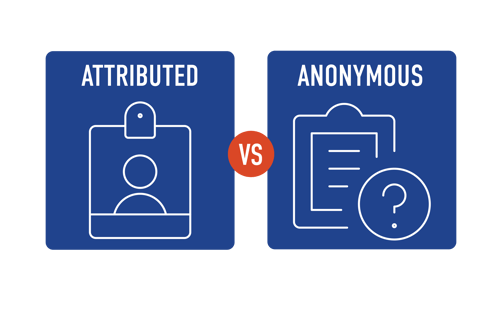
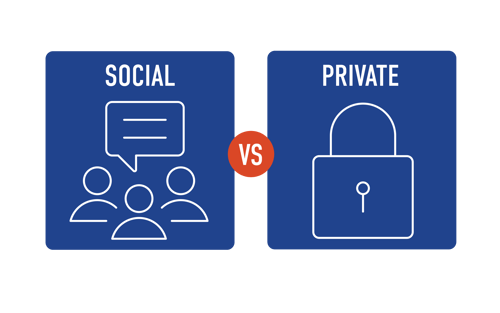
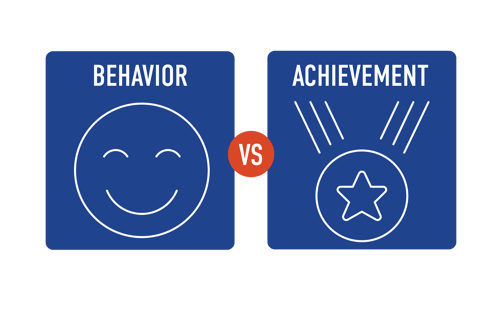
The “how” of recognition is very important. Every employee embraces recognition differently. Some get a boost from public praise, while introverted workers prefer a subtle or private gesture. After identifying the employee’s personality type, openly encourage them through the types of recognition that mean the most to them.
Peer vs. superior
 |
|
Attributed vs. anonymous
 |
|
Social vs. private
 |
|
Behavior vs. achievement
 |
|
The types of recognition employees crave most
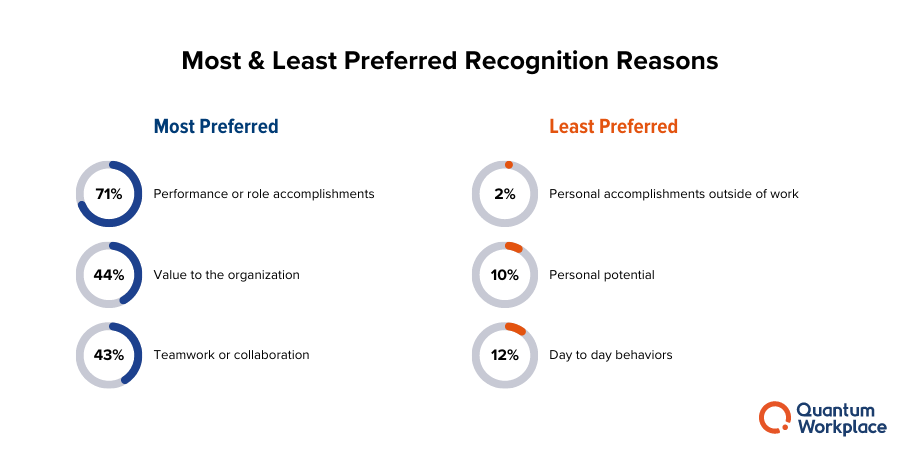
Different employees care about different things. But our research shows the most and least preferred reasons for recognition—with performance or role accomplishments, value to the organization, and teamwork or collaboration coming out on top.
Recognition works best when it's consistent and embedded
Not all recognition programs are created equal. Our research identifies five distinct states of recognition—ranging from rare or absent, to inconsistent and random, top-down only, and controlled and programmatic, all the way to consistent and embedded. Only one of these states reliably delivers the outcomes leaders care about most: retention, engagement, and advocacy.
Consistent and embedded recognition means it’s frequent, meaningful, and visible—and employees at every level, not just managers, are empowered to give and receive it. It isn’t confined to a single campaign or approval chain. It’s simply part of how the organization operates day to day.
The impact of getting this right is substantial. Employees at organizations with consistent and embedded recognition programs are more than twice as likely to stay as employees at organizations with other types of programs. And when recognition is designed this way, employees are 7.2x more likely to say it would take a lot to get them to leave.
The good news is that many organizations are already on the right path. More than half (53%) of organizations with a formal recognition program describe their culture as consistent and embedded. But there’s still a long way to go— 3 in 5 employees say recognition at their organization is inconsistent, top-down, gated by approvals, or nearly absent.
The takeaway for leaders is simple: recognition works best when it isn’t confined to a program or a single person to administer—it works best when it’s built into the culture itself, so that great work is consistently seen, no matter who does it or who’s watching.
12 employee recognition statistics
Employees want to feel valued at work. They want recognition for their contributions to team and organizational success.
While extremely important, recognition isn't only about making employees more engaged and feeling good about their job. It can be a differentiator for organizations in their employee value proposition and can affect an employee’s intent to stay at an organization.
Here, we look at 12 statistics that demonstrate the importance of employee recognition on employee, team, and business success.
1. The #3 reason most people leave their jobs is a lack of recognition.
Source: Quantum Workplace 2024 Research
Don’t miss an opportunity to recognize your employees. Celebrate employee accomplishments and progress throughout the employee cycle to demonstrate your investment in their career growth and success. Regular, frequent recognition shows you want to help keep them motivated to hit future milestones.
Pro Tip: Authentically recognize employees in real-time.
2. When recognition is designed well, employees are 7.2x more likely to say it would take a lot to get them to leave their organization.
Source: Quantum Workplace, 2026 Recognition Research Report
Recognition isn’t just a feel-good gesture—it’s one of the strongest levers for retention. When it’s frequent, meaningful, and visible, employees form a much stronger connection to their organization and are far less likely to walk away.
Pro Tip: Audit whether your recognition program is actually frequent, meaningful, and visible—the three traits research ties to retention.
3. 67% of organizations have a formal recognition program, but 40% of employees still don’t feel the recognition they receive is meaningful.
Source: Quantum Workplace, 2026 Recognition Research Report
Having a program isn’t the same as having an effective one. Intent and impact are two different things, and the gap between them usually comes down to program design rather than effort.
Pro Tip: Don’t just launch a program—regularly check whether employees actually feel the recognition it produces.
4. 52.5% of employees want more recognition from their immediate manager.
Source: Recognition in the Workplace, Quantum Workplace and BambooHR
Recognition should be public and available to all employees—especially managers. Employees want to know what they are doing well, how they can improve, and what support they have available to them. Public recognition gives managers visibility into how often their employees are giving and receiving recognition to impact their engagement individually.
Pro Tip: Make recognition public and easy to give.
5. 1 in 5 employees have received zero recognition in the past year.
Source: Quantum Workplace, 2026 Recognition Research Report
For a meaningful share of the workforce, recognition simply isn’t happening at all. Employees who go completely unrecognized are at the highest risk of disengagement and turnover.
Pro Tip: Build recognition into regular check-ins and workflows so no employee falls through the cracks.
6. 4 in 10 respondents (41%) want more recognition from their immediate coworkers.
Source: Recognition in the Workplace, Quantum Workplace and BambooHR
Recognition from immediate managers is key—but so is recognition from peers and coworkers. Give your team members plenty of opportunities to encourage each other and show appreciation. Peers often have more insight into employee effort and morale than senior leaders.
Pro Tip: Treat employees as valued team members, not as numbers.
7. Only 5% of employees receive recognition weekly or more often.
Source: Quantum Workplace, 2026 Recognition Research Report
Frequency matters. As recognition happens more often, employees report feeling both more engaged and more likely to stay—but most organizations recognize far too rarely to see that benefit.
Pro Tip: Build recognition into the flow of everyday work instead of saving it for big milestones.
8. Of employees who receive recognition monthly or more, 80% are highly engaged.
Source: Quantum Workplace, 2026 Recognition Research Report
Consistency pays off. Employees who are recognized on a regular cadence are dramatically more engaged than those who go long stretches without acknowledgment.
Pro Tip: Set a cadence goal for recognition frequency and track it like any other engagement metric.
9. In the weeks after being recognized, 65% of employees look for more ways to contribute, 59% put in extra effort, and 56% stay longer.
Source: Quantum Workplace, 2026 Recognition Research Report
Recognition doesn’t just feel good in the moment—it changes behavior. Employees who are recognized carry that motivation forward into how they show up at work.
Pro Tip: Frame recognition as an investment in future performance, not just a reward for the past.
10. Employees who receive rewards alongside recognition are 4.8x more likely to say the recognition is meaningful.
Source: Quantum Workplace, 2026 Recognition Research Report
Pairing recognition with even a small reward significantly boosts how much it resonates with employees. The reward doesn’t have to be expensive—it just has to be there.
Pro Tip: Add a reward option to recognition moments, even a modest one, to help the acknowledgment stick.
11. 87% of employees with reward choice say the recognition they receive is meaningful, compared to just 52% of those without choice.
Source: Quantum Workplace, 2026 Recognition Research Report
Personalization matters as much as the reward itself. When employees can direct a reward toward something that actually matters to them, recognition stops feeling like a transaction.
Pro Tip: Offer flexible reward options so employees can choose what’s meaningful to them.
12. When companies spend 1% or more of payroll on recognition, 85% notice a positive impact on engagement.
Source: SHRM Globoforce Employee Recognition Survey
Awards, compensation, and incentives are good appreciation ideas, but make sure they aren't your only outlet for recognizing employees. Consider an investment in user-friendly employee recognition software to make every aspect of your employee recognition more efficient, more accessible, and more personable.
Pro Tip: Choose the right employee recognition platform.

Employee recognition examples
Recognition and appreciation are essential in a healthy work environment. But finding the right words to recognize employees may seem unnatural or uncomfortable without the right experience. While you should tweak your messages to resonate with each employee, we’ve compiled a list of recognition ideas to guide your efforts.
Recognizing excellent performance
- “Thank you for always going above and beyond in your work. You are a great asset to this team!”
- “Your ability to drive consistent business outcomes is inspiring. Thank you for everything you contribute to this company!”
- “I want to take a moment to acknowledge you for all of your hard work. You’re growing and continuing to set a higher standard everyday.”
Recognizing good attitudes
- “Your constant positivity makes the work environment better everyday. I’m always excited when I get to work alongside you!”
- “Thank you for helping out with this project. You’re a huge asset to this team and it doesn’t go unnoticed!”
- “Thank you for living out our company values day-in and day-out. You set a good example for everyone on our team.”
Recognizing goal accomplishment
- “Your ability to persevere and meet this goal is inspiring! Despite any roadblocks you face, you always pull through and drive amazing outcomes.”
- “Great job exceeding your goals the past quarter! Your talent and drive is key to our business.”
- “Your adaptability and ability to take on any challenge is impressive. You completely exceeded my expectations with this project!”
5 best practices for designing a successful employee recognition program
Many organizations invest in recognition programs—but far fewer build a true culture of recognition. The difference isn’t intent. It’s design.
When recognition is slowed by approvals, limited to certain roles, or treated as a “nice to have,” it loses its impact. But when it’s intentionally designed to be frequent, meaningful, and visible, it does something much bigger: it drives performance, strengthens connection, and turns everyday work into insight.
The most effective recognition programs go beyond celebrating employees—they shape behavior, reinforce what matters, and help leaders see where impact is happening.
Here’s how to design one that actually works.
1. Recognize what matters most.
Recognition should reinforce the behaviors and outcomes that drive your business forward—not just reward activity.
That means moving beyond generic praise (“great job!”) and instead highlighting specific contributions tied to impact, effort, and core values. When employees understand why their work matters, they’re more likely to repeat it.
Strong programs also connect recognition to meaningful moments—like goal completion, key milestones, or growth experiences—so appreciation reinforces progress, not just participation.
2. Make recognition meaningful to the individual.
Recognition only works if it feels personal.
A one-size-fits-all approach—whether in messaging or rewards—quickly becomes forgettable. Instead, give employees flexibility in how they’re recognized, from personalized messages to reward choice that reflects what they actually value.
When recognition feels relevant and human, it becomes motivating. When it feels generic, it becomes noise.
3. Make recognition easy and frequent.
Recognition should happen in the flow of work—not as an extra task.
If giving recognition requires approvals, long forms, or perfect timing, it won’t happen often enough to matter. The best programs remove friction by making recognition simple, fast, and accessible in everyday tools like Slack or Teams.
Frequency is what builds culture. When recognition becomes a natural, repeatable habit—not an occasional event—it starts to shape how people work and interact every day.
4. Make recognition visible across the organization.
Recognition has the most impact when it’s seen—not just by the recipient, but by everyone.
Public recognition creates shared understanding of what great work looks like. It reinforces values, spreads positive behaviors, and builds connection across teams.
When anyone can recognize great work—and leaders model it consistently—recognition scales from isolated moments into a visible, self-reinforcing culture.
5. Design recognition as a signal, not just a moment.
Recognition shouldn’t just celebrate the past—it should inform the future.
When recognition is frequent, aligned, and visible, it creates patterns. Over time, those patterns reveal who is driving impact, where collaboration is working, and what behaviors are moving the business forward.
This turns recognition into more than appreciation—it becomes insight. Leaders can use it to coach more effectively, invest in the right people, and reinforce what matters most.
How to choose the right employee recognition software
Design principles matter—but the platform you choose will either reinforce those behaviors or quietly work against them.
Many employee recognition software check the box. Fewer are designed to actually build a culture of recognition—one that is frequent, visible, and aligned to what drives performance.
As you evaluate your options, the goal isn’t just to find a platform with features. It’s to choose one that makes the right behaviors inevitable.
Here’s what to look for.
Look for Recognition That’s Built for Everyone—Not Just Managers
Recognition should be something every employee can participate in—not something controlled at the top.
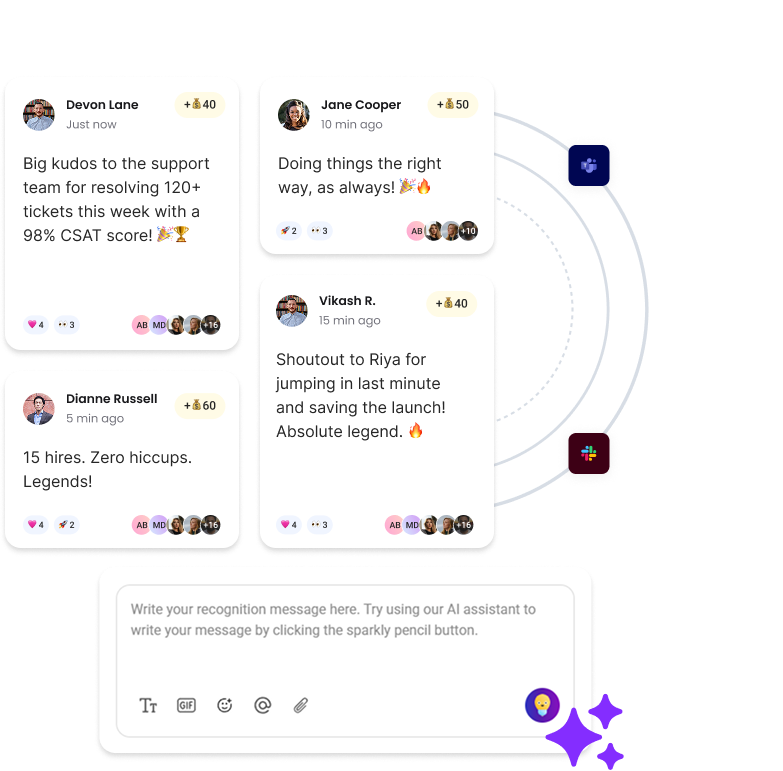
That means enabling peer-to-peer recognition, where anyone can recognize great work in real time. The most effective platforms also make recognition interactive—through features like comments, reactions, or the ability to amplify recognition—so appreciation becomes visible and shared across teams.
When recognition is open and participatory, it scales naturally. When it’s restricted, it slows down.
Prioritize Ease and Integration Into the Flow of Work
If recognition feels like extra work, it won’t happen often enough to matter.
Look for platforms that integrate into tools employees already use—like Slack, Microsoft Teams, or your HR systems—so recognition can happen in the moment, not after the fact. Features like simple posting flows or even AI-assisted writing can also help employees give more thoughtful, specific recognition without friction.
The easier it is to recognize great work, the more consistently it happens—and consistency is what builds culture.
Make Sure Rewards Reinforce (Not Replace) Recognition
Rewards shouldn’t be the point—but they should add momentum.
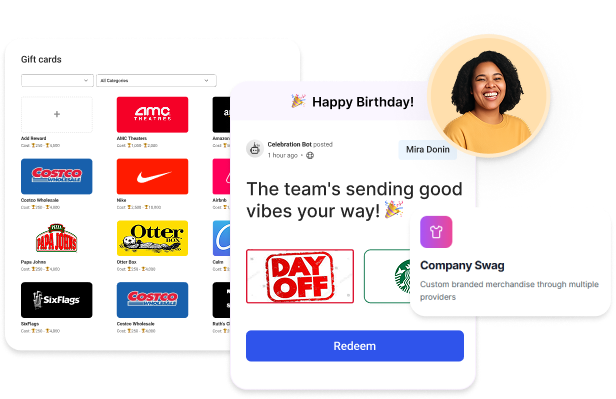
The right platforms allow you to pair recognition with flexible, meaningful rewards—like points employees can redeem for a wide range of options that fit their preferences. This ensures rewards feel personal and proportional to the impact being recognized.
When rewards are designed well, they don’t dilute recognition—they reinforce it, helping appreciation stick and motivating continued performance.
Choose a Platform That Scales Recognition Across Moments
Recognition shouldn’t rely on memory or manual effort.
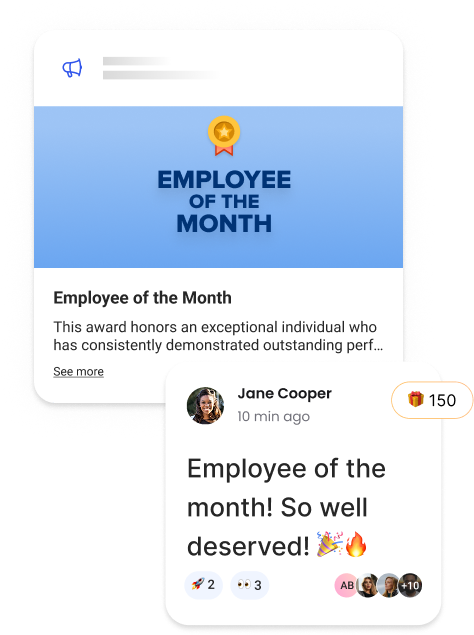
Look for features that help you consistently recognize key moments—like milestones, anniversaries, or major contributions—without requiring someone to remember every time. This often includes automated triggers through HRIS integrations, as well as structured awards or campaigns that highlight specific behaviors.
This creates a more consistent and equitable experience—where recognition isn’t just frequent, but reliably delivered across the organization.
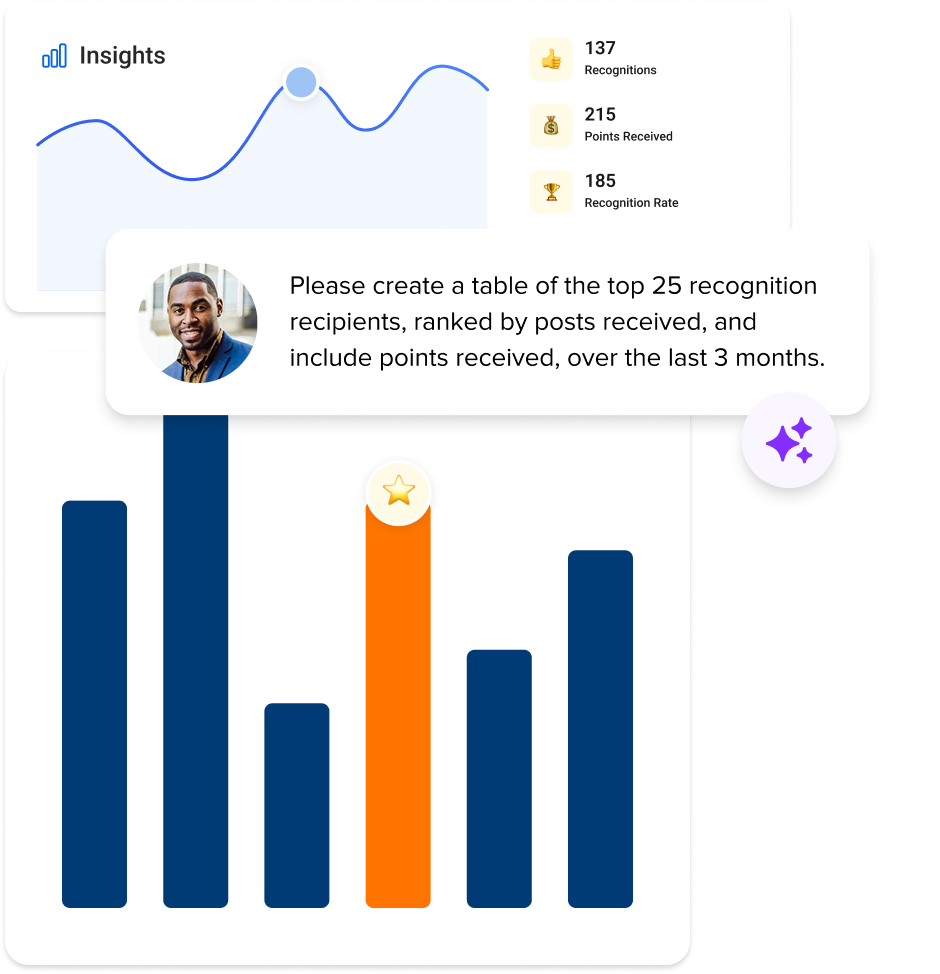
Don’t Overlook Analytics—Recognition Should Create Insight
Recognition data is one of the most underutilized signals in an organization.
The right platform will surface patterns—showing who is being recognized, for what, and where participation is strong or lacking. Dashboards and reporting tools can help leaders identify high-impact contributors, uncover gaps, and better understand how work is getting done across teams.
This is where recognition becomes more than a moment. It becomes a system of insight—helping leaders coach more effectively, invest more strategically, and reinforce what drives results.
Final Thought
Most organizations evaluate recognition platforms based on features. The better question is: Will this platform help us build a culture where recognition actually happens?
Because the goal isn’t to implement a tool—it’s to create an environment where great work is consistently seen, reinforced, and repeated.
That’s what turns recognition from a program into a performance driver.