



In our research, we found that the ideal span of control sits between eight and nine direct reports. Go much beyond that, and manager effectiveness and team dynamics start to slip. Once those two areas weaken, engagement and nearly every other part of the employee experience follow them down.

What is span of control?
Span of control is the number of employees who report directly to one manager. It does not include downstream reports, meaning people who report to someone else on that team.
We studied this using both raw span, the actual headcount, and relative span, how a manager's team compares to their own organization's average. Both versions point to the same patterns.
For example, a marketing manager has six people reporting directly to her. One of those six, a content lead, has four specialists reporting to him. Those four specialists are downstream reports, not part of her span of control. Her span of control is six, not ten.
Figuring out the right team size is genuinely hard. Give a manager too few people, and they can feel underused or disconnected from real leadership work. Give them too many, and even a talented manager can start to burn out. We wanted a clear, data backed answer to help.
What factors influence span of control?
Team size is not just a matter of preference. Several factors shape how many direct reports a manager ends up with.
● Industry and business structure. Retail and industrial companies often show larger spans of control, since one general manager may oversee an entire store or factory floor with no layer in between.
● Manager's level in the organization. Senior leaders often carry larger, more strategic teams, while frontline managers tend to stay closer to the recommended range.
● Organizational standardization. Companies with clear role descriptions and consistent evaluation criteria appear better able to sustain larger teams without losing manager effectiveness.
● Company size. Larger organizations sometimes set different informal norms for team size than smaller ones.
● Reporting structure and org chart accuracy. Some employees act as informal team leads without a corresponding change in the org chart, which can understate a manager's true span.
Even so, industry alone does not reliably predict weaker manager effectiveness or team dynamics. The core relationship between span of control and engagement held steady across company size and sector.
How span of control impacts manager engagement
We analyzed engagement levels across more than 20,000 managers and 169 organizations. The chart below shows manager engagement by number of direct reports, from one to fourteen. Because smaller companies often report higher engagement than larger ones, we also broke results out by organization size.
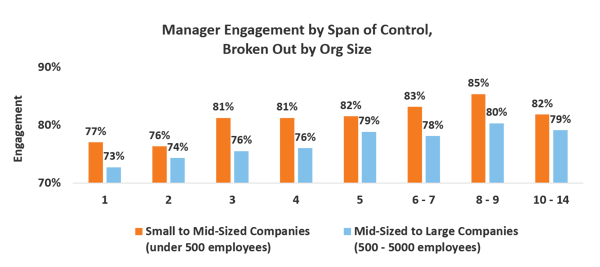
Engagement is lowest for managers with one to two direct reports. It climbs steadily, peaks at eight to nine direct reports, then declines again. This is what's called a curvilinear trend.
This pattern points to a sweet spot. In both smaller and larger organizations, manager engagement peaks around eight to nine direct reports. The differences are not huge, but two clear trends stand out.
● Managers with smaller teams tend to be less engaged
● Manager engagement peaks with eight to nine direct reports
How team size affects manager effectiveness and employee engagement
We recently took this analysis further to understand the mechanism behind these results. Using survey responses from thousands of employees, we tested how span of control connects to manager effectiveness, team dynamics, and eight other engagement related outcomes.
The pattern is clear. A larger span of control weakens manager effectiveness and team dynamics first. Those two areas then drive changes in individual needs, career growth, communication, trust in leadership, diversity and inclusion, future outlook, and overall engagement.
When manager effectiveness and team dynamics hold steady, a bigger team does not have to hurt the employee experience. Outcomes can even improve slightly. The real risk shows up only when those two areas weaken under a growing span.
The two levers that matter most: manager effectiveness and team dynamics
Manager effectiveness and team dynamics act as the bridge between span of control and engagement. Protecting them is the highest leverage move an organization can make.
Trust in leadership also plays a supporting role. It carries about as much weight in driving engagement as manager effectiveness and team dynamics do on their own.
Span of Control Thresholds: Where Manager Effectiveness Starts to Drop
Looking at raw team size, manager effectiveness favorability holds fairly steady through eight direct reports. It dips slightly at nine to sixteen, drops more noticeably at seventeen to thirty two, and falls below the 70 percent favorability benchmark once a manager has thirty three or more direct reports.
|
Direct Reports (Raw Count) |
Manager Effectiveness Favorability |
|
1 to 8 |
Holds steady, around 70% |
|
9 to 16 |
Small dip, about 2 points |
|
17 to 32 |
Noticeable decline |
|
33 to 64 |
Drops below 70% |
|
65 or more |
Falls to about 63% |
Comparing a manager's team size to their own organization's average tells a similar story, and it kicks in earlier.
|
Span vs. Org Average |
Manager Effectiveness Favorability |
|
More than 1.5 SD below average |
Highest favorability |
|
0.5 to 1.5 SD below average |
Above average favorability |
|
Within 0.5 SD of average |
About 70% |
|
More than 0.5 SD above average |
Drops to about 67% |
|
More than 1.5 SD above average |
Falls to about 63% |
Only about a quarter of employees have a manager with more than nine direct reports. Extremely large teams are rare, and the pattern held consistently across company size and industry.
How team size changes which lever matters most for engagement
Team dynamics and manager effectiveness do not carry equal weight at every team size.
For smaller teams, strong team dynamics protect engagement the most. For larger teams, manager effectiveness becomes the bigger driver.
This means the right fix depends on team size. A small team with low career growth scores may need stronger team dynamics. A large team with the same problem may need stronger manager support instead.
For example, a four-person team and a twenty-person team both score low on career growth. For the four-person team, the fix is building trust and connection among teammates. For the twenty-person team, the fix is giving the manager more coaching and development support.
How to assess your team's span of control
A few concrete steps can help you see where your organization stands, and where to focus first.
● Count direct reports, not downstream reports. Pull each manager's actual headcount from your HRIS, and confirm it reflects only people who report to them directly.
● Calculate your organization's average span. Add up direct reports across all people managers, then divide by the number of managers, to set your baseline.
● Flag managers above that average. Managers whose span sits more than half a standard deviation above the org average are where favorability tends to dip first.
● Pull manager effectiveness and team dynamics scores. Review recent engagement survey results for these two areas for every manager, starting with those flagged above.
● Identify your "scalers." Look for managers with an above average span who still score high on manager effectiveness, and note them as coaching resources.
● Flag managers who need support instead of a smaller team. Watch for average or below average span paired with low manager effectiveness or team dynamics scores, since that points to a skill gap, not team size.
● Match your fix to team size. Invest in team building for smaller, low scoring teams, and in manager coaching and support for larger, low scoring teams.
● Add span of control as a standard survey demographic. Build it into your next survey cycle, so you can track these patterns automatically going forward.
Frequently Asked Questions
What is span of control?
Span of control is the number of employees who report directly to one manager. It excludes anyone who reports to someone else on the team.
What is the ideal number of direct reports for a manager?
Our research points to eight to nine direct reports as the sweet spot for manager engagement and effectiveness.
Does a bigger team always mean lower engagement?
No. Engagement holds steady when manager effectiveness and team dynamics stay strong, regardless of team size.
What matters more than the number of direct reports?
Manager effectiveness and team dynamics matter more. They are the two factors that most directly shape engagement outcomes.
Does industry change the ideal span of control?
Not meaningfully. Our analysis found no significant differences across industries, though industrial and retail teams trended slightly larger.
What can HR leaders do to support managers with large teams?
Track span of control, invest in manager effectiveness and team dynamics, and identify managers who scale well so they can coach others.
Keeping track of the productivity and progression of a large team, let alone developing healthy working relationships with each team member, can sound overwhelming. However, we have just the resource to help you tackle those challenges. Check out our free e-book, The Manager Jackpot: Simple HR Solutions for Building Better Bosses